
Introduction
For my first proper trip away since lockdown, I am travelling on a Senior Interail Pass (15 train travel days within two months) to Norway and back for a Hurtigruten boat trip up the Norwegian coast to the far north. I’d originally planned to spend the winter solstice in the Arctic Circle but plans changed and it all got delayed by a month.
Bella
Looking after Bella was a secondary reason why I left Sidmouth a bit later than I would otherwise have done, and this is my excuse for including the sweet Bella in this blog!


Wednesday 4th – Friday 6th January: Sidmouth to Hamburg, north Germany
Trains were on strike, coaches seemed awkward and uncertain, I wasn’t sure when I’d be ready to leave the house, so instead of booking anything, had decided to throw myself on fate.
Wednesday morning, I am up surprisingly early, put out clean bird feeders, wash the others ready for the bird-sitter, and set off early. A nationwide government scheme brought in two days earlier means the bus into Exeter is £2 instead of £8.50. Walking from the bus station to the train station I pass the EE shop, pop in, and emerge minutes later with my phone set up for European roaming. It turns out there are a few trains running and I catch the 11.15 to Paddington.
Next stop St Pancras to get a ticket to Europe. Checking earlier on line it seemed the only Interail compatible tickets were at the crack of dawn – a prospect I was not looking forward to. From previous experience, I was also not looking forward to throwing myself on the mercy of Eurostar officials. However the man I see could not have been nicer and more helpful, and I am soon equipped with a £26 ticket to Brussels at 13.00 for tomorrow, Thursday.
I stay overnight with Susi and Crispin, and Crispin, thinking about the frozen poles, tells me about ‘The Worst Journey in the World’ a book by Apsley Cherry-Garrard relating his experience in search of an Emperor Penguin’s egg on Scott’s second (ill-fated) trip to the Antarctic. On Thursday morning Susi and Crispin persuade me that I really should take out travel insurance, a process which, with their moral support and my PO Money Card App, takes me all of about ten minutes. And Hatchards at St Pancras has a copy of ‘The Worst Journey …’ (though sadly not by Penguin).
Eurostar goes smoothly. I chat to a student in the seat next to me who is studying international relations and hopes to get a job in the diplomatic service based in Taiwan. As he explains it, it sounds a jolly good career plan. He also seems like he’d be good at it. Young people are facing a tough world. I’m not sure I’d want to be starting out again now.
I haven’t done anything about a hotel in Brussels, largely because I am not particularly enthusiastic about spending a night there. Instead, having checked the next stage of my journey and seen the first leg seemed to be to Aachen, I decide to push on there.

Aachen, I discover during an evening wander, has a wonderful medieval centre. I am too early in my journey to stay another day but I shall try to visit with more time another time.
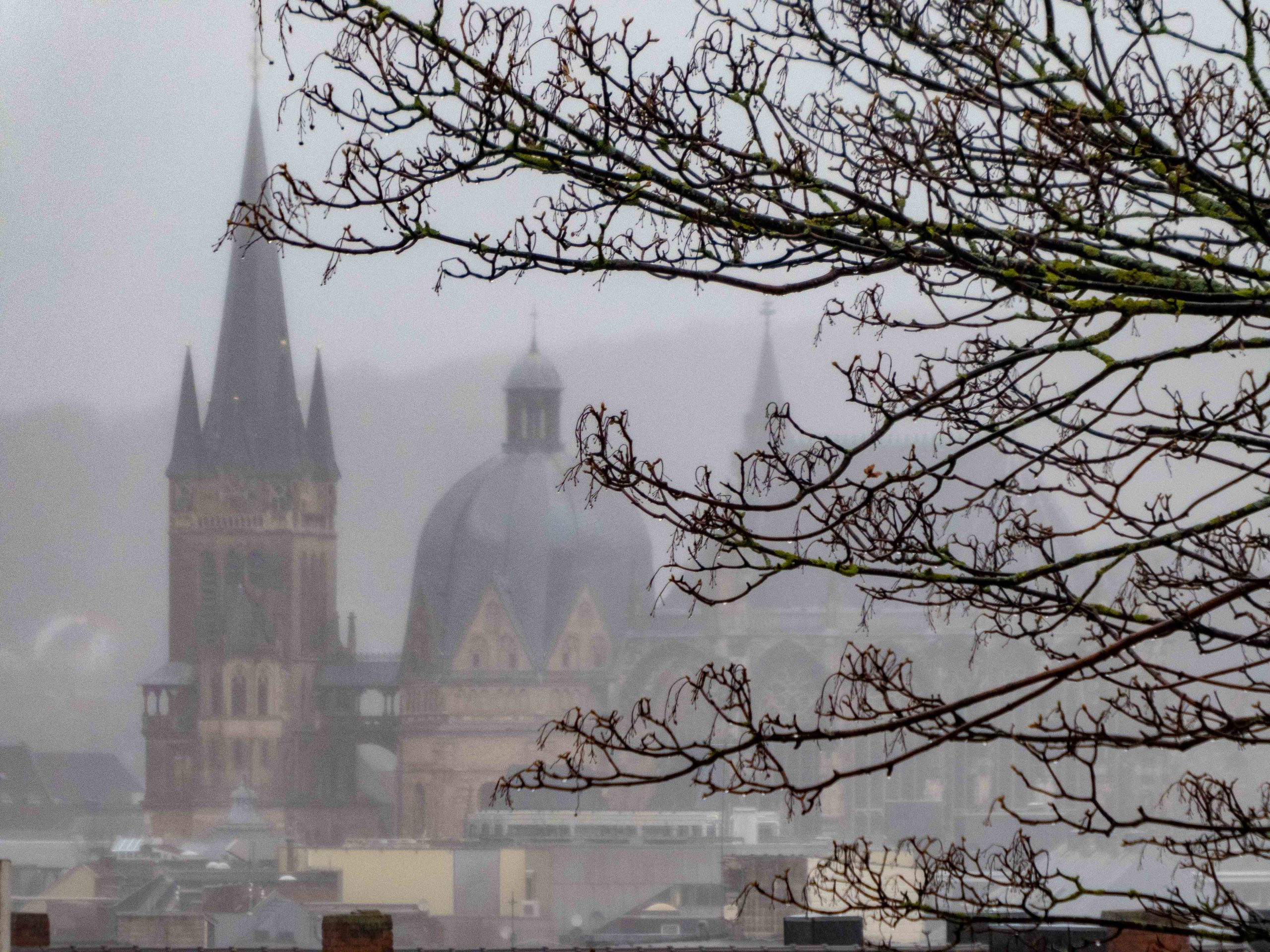
Instead I spend Friday on a train to Hamburg alternating between reading ‘The Worst Journey …’, looking out of the window at the passing countryside, and looking on the internet at maps of Antarctica and of the north German canal system.
In Hamburg I’ve booked a hotel opposite the station for a night however there is a slight problem with my room, and the receptionist unexpectedly tranfers me at no extra cost to a higher spec sister hotel nearby which is so nice I decide straightaway to book a second night (I have been feeling in need of a rest day anyway). Pushing my luck I ask the equally kind receptionist in the sister hotel if there is any chance of including breakfast in the price, and after a moment he agrees. [Coming up next – my day in Hamburg and hopefully a few pictures!].

Friday evening I feel obliged to check out the famous Hamburg nightlife but after a vegan meal (a noodled variation on the ubiquitous Buddha bowl), a couple of beers in Bar Belini (small, friendly atmosphere) and checking out a couple of others (including, briefly, the in/famous S.L.U.T.), I trundle happily home to bed.
Saturday 7th January: Hamburg, Germany
Saturday morning I re-learn how to use this website, how to get photos from my phone onto my computer, and write the section above. Then, into an overcast afternoon, I set off for a wander. Hamburg was founded around the navigable Elbe, so I aim for the water.
My path takes me back through the railway station. One of the few specific tasks I’ve set myself for this trip is to buy a 2023 diary as Leuchtturm, German and my preferred brand, is difficult to buy in UK. I’d chanced upon Leuchtturm while pissed off at Moleskine, whose too bloated diaries I’d used for years, for failing even to acknowledge my improvement suggestions. Anyway, extraordinarily I find exactly the diary I use (A6 soft cover week-planner and notebook) in a station book shop, which also has two cheap English-language pocket volumes of Oscar Wilde’s wonderful short stories.
Less successful is my first attempt with my new PO money card at a station cashpont. Thinking I can remember the PIN, I jab away at the number pad in frustration until it locks me out.

En route to the Elbe I pass the Chilehous, an exceptional example of 1920s Brick Expressionism and a fine building which I is assume is an upmarket appartment block but is apparently offices. Hamburg seems to have a lot of massive buildings, not necessarily hugely tall, but nevertheless massive.

Speicherstadt, a UNESCO World Heritage site, claims to be the world’s largest warehouse complex. Perhaps it was when ‘it was built into the Elbe river between 1883 and the late 1920s on thousands of oak poles as a free economic zone within Hamburg’s port’ – possibly the last gasp of the Hansa League – and perhaps it still is, but either way it is impressive. Sadly the UK’s soon to be free economic zones are not to be so tightly circumscribed and are unlikely ever to become UNESCO WHSs.

Again I assume it is mostly now upmarket appartments but apparently not. They are used for storing carpets, tea, coffee, and other things and the use of the buildings is tightly regulated with permission needed even to put a picture on an inside wall, details I learn from the friendly man managing the delightful Wasserschloss Teekontor cafe/restaurant where I stop for coffee and cake and start reading Oscar Wilde’s The Canterville Ghost.

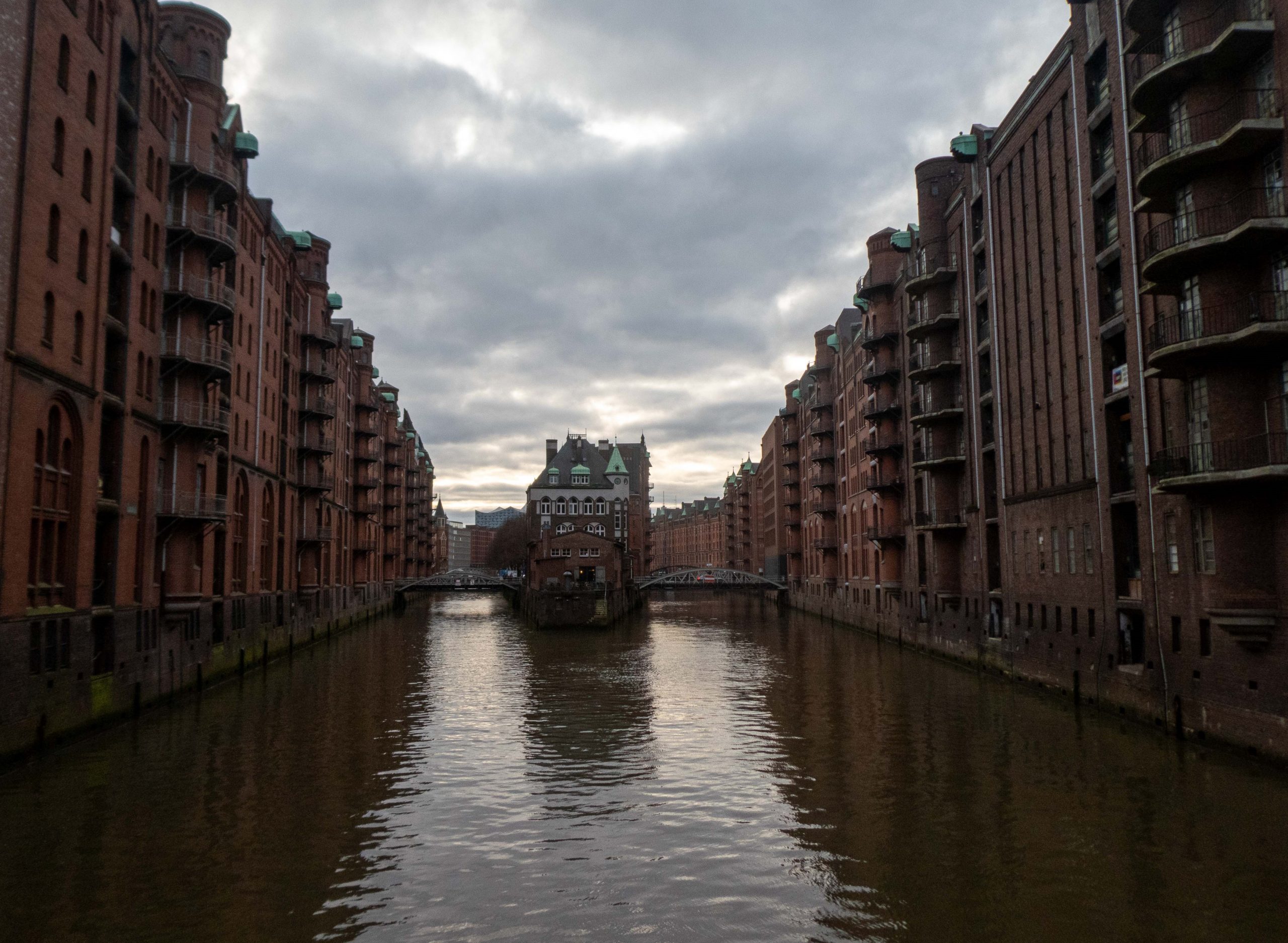

From Speicherstadt I follow the north side of the Elbe west as best I can – not easy because there is a lot of waterfront development going on, not particularly harmonious – round to the new Elbphilharmonie, a monstrosity of a building.


Now dark, I cut up through the inner city canals and basins, past a war ruined church, …


… traverse a buzzing up market shopping quarter – what a vibrant city Hamburg still is – and so back to the hotel and a very friendly local Italian restaurant for supper, a beer, and bed.
Sunday 8th January: Hamburg, Germany to Goteborg, Sweden
Next morning, Sunday, I catch the 08.56 train from Hamburg, through Copenhagen, to Goteborg. I am keen to get through Copenhagen without spending a night because, although there are bound to be nice bits, I hadn’t found them when I passed through in 2019 on my trip around the Baltic.
Outside the carriage the flat, rural, water-cut land of Schleswig-Holstein merges into south Denmark with its long bridges while inside, a group behind me talk about micro-brewing, niche marketing, and management of beers and sprits and I get chatting to a couple of students.
A young Swede (how useful it is when a nation has a collective noun for its citizens!) sitting opposite me (on his way back from skiing with his father and sister at Les Arcs in the Alps and unlike them not wanting to fly) is doing an MSc in sustainability in Uppsala, an antidote to the unsustainable economics he’d studied in his first degree. The other, a young French social scientist (sitting across the aisle and by chance also returning from the Alps where her family lives and also not wanting to fly) is doing a PhD in Oslo on local people’s engagement with rewilding, based around a green macaw re-introduction project in Argentina she’s been working at as a volunteer. How encouraging to hear young people engaging with the planet, to hear Argentina engaging with rewilding. The PhD student hopes to return to Argentina for a while at least when she has finished. I don’t ask the MSc student how he envisages his future as he seems less fully formed and I don’t want to unsettle him with my inquisition.
Arriving into Copenhagen (13.34) and before we get off and go our seperate ways, we, Interailers three, have a quick conversation about how brilliant the Interail App is, bringing together and integrating the train timetables of every train company in Europe! Still unaware of how brilliant the PO travel money card can be, I wander round Copenhagen station and refrain from purchasing a coffee as I don’t have any local currency.
But soon (14.27) I am Goteborg bound. My hotel, when I arrive (at 18.20), is in the station which is very easy. They also have a complementary bowl of toffees, one of which I take as I head to my room. Soon my mouth is full of toffee mixed with fragments of broken filling from my lower left rear molar. Nevetheless, a quick visual inspection suggests I am not yet at the full broken mouthed old ewe stage (what a tragic thought that is, doomed to a slow death from starvation as one’s teeth disintegrate), and head out for some soft pasta and a beer. I am thinking how quiet the centre of Goteborg is until I remember it is a damp Sunday evening in early January.
City’s feel so daunting when you arrive at night without any references or barings. I feel lucky to be able so quickly to access safe spaces, begin to develop a mental map of my surroundings, and move into the thrill of exploration.
Monday 9th January: Goteborg, Sweden
Monday morning in Goteborg. I discover the hotel’s excellent wellness centre with machines I can use to stretch and exercise my back. I work more on my blog, reminding myself this time how to get photos from my camera to my computer (what a task this all is!).
My PO card, I am happy to say, is back in action. A call to the help desk, and trying it again here in Sweden, all is now well. Sweden seems pretty much cash free, so I have loaded it with Swedish kronor, am having to use it for every little transaction, and am starting to realise how brilliant it is.
I set out into the rain. Again I aim for the water. This time it is to what was a natural harbour on Sweden’s short western coast, north of the straits that protect the Baltic, and opposite the top end of the Denmark peninsula, that has become the west end of the Gotakanal which links Goteborg more safely with Stockholm through south Sweden’s watery centre with its inner seas. Apparently some king granted Goteborg the right to establish itself as a fortified centre and it strikes me how part of nationhood seems to be about remembering a list of kings who measure out our histories.

I cross a big new bridge for the views, return, and follow the canal east a short way.


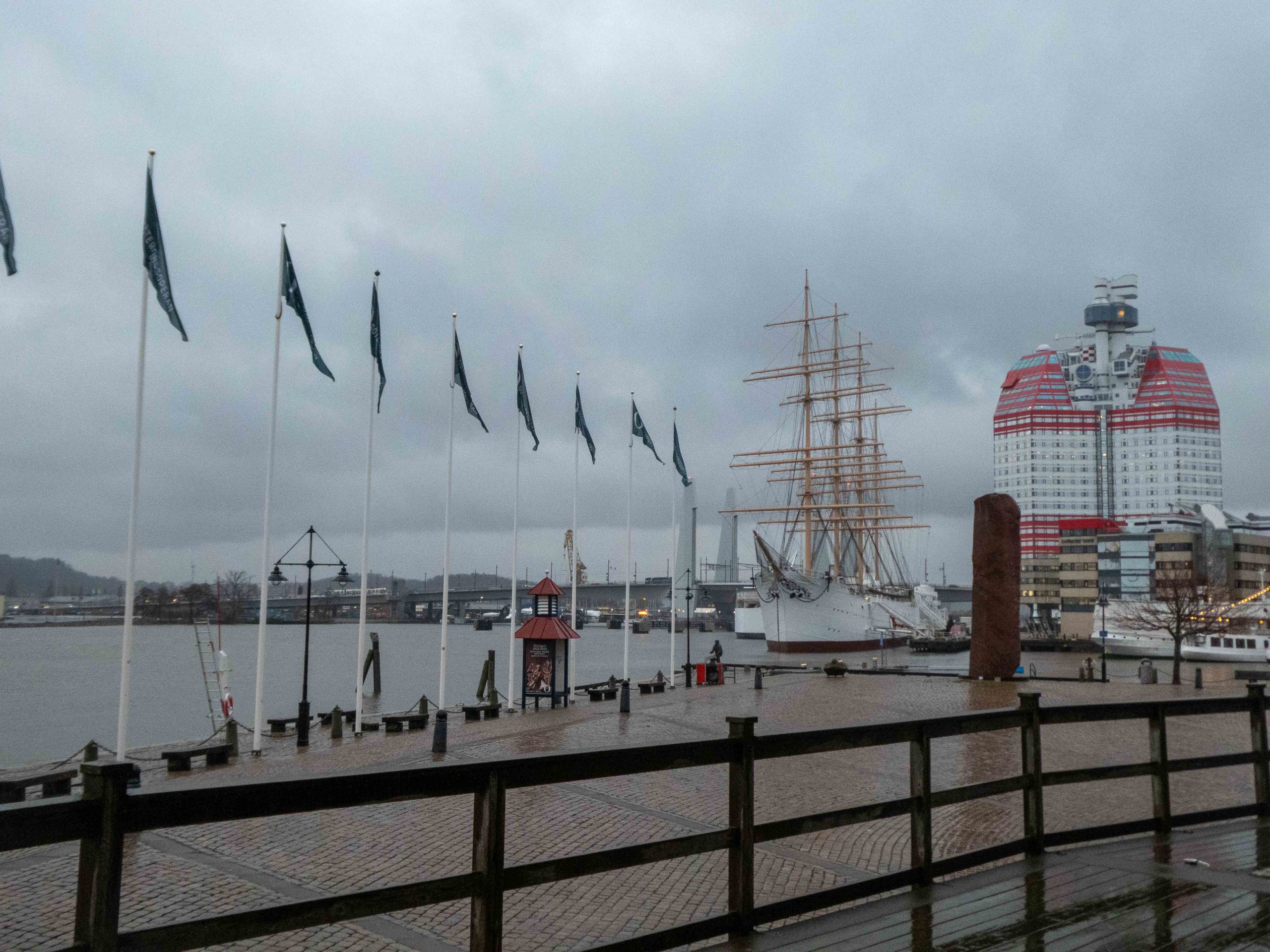

Passing a shop front I am amused by these scenes from the future, complete with cuddly toy assistance animals for comfort.


Finally I find an open cafe where I eat ‘apple pie pancakes’ which sound the least sweet thing on the menu …

… then loop anti-clockwise through the gardens along the moat that formed part of the old town’s fortifications, and so back to the Central Station and my hotel.


Much of the town seems to be disrupted by obtrusive civil works which seem to be devastating old Goteborg. However apparently they are building an underground train system and presumably once it is all finished, everything on the surface will look as old as it ever did, perhaps.
Tuesday 10th January: from Goteborg, Sweden to Oslo, Norway
Run out of time, train to catch (from Oslo to Bergen), will add text for this section later!
So, Goteborg has been a good stop. A good hotel breakfast, another wellness session to stretch my back, a session on photos in the hotel lobby, then a cup of coffee down in the station before getting the 14.15 train to Oslo.

As with the Honiton to Waterloo line, the train follows water, though the countryside is completely unlike Devon or Dorset. First we ride alongside the Gotakanal as far as Trollhattan where the canal enters Vanern, a large lake, and we turn north. For the first time we are surrounded by settled snow and it starts to feel more of a northern adventure.

The train is quite empty up through Sweden. I am accompanied by a fluffy dog and her owner as far as Ed where they transfer to a bus to remote Bengtsfors where she (the human, not the dog) studies textile design at a rural art college.

It is getting dark when we cross into Norway. The countryside gets hillier but it also feels less remote as we drop down towards the coast, the stops get closer and the train gets busier until we arrive into Oslo at 17.43. It is a pleasant 20 minute walk through the city to my hotel.
I go for a pizza and discover The London Pub, Oslo’s oldest gay bar, is just up the street. It proves to be a real old fashioned gay bar and they are getting ready for karaoke. Planning just a quick drink, I am rather unexpectedly adopted by a group of three young nurses and end up staying till closing time. It is an interesting evening.
Wednesday 11th January: Oslo, Norway
In the morning to my surprise, I don’t have a hangover; the slightly dingy hotel I am staying in has a great breakfast: potatoes, rough chopped onions, peppers, mushrooms and some other veg, and Norwegian baked beans – all very good and well cooked – alongside the usual breakfast buffet (naughtily I make a cheese and tomato roll for lunch later); and the sun is shining!
The Interail App tells me I need a reservation for Oslo-Bergen tomorrow so I need to go to the station but take the long way round by the harbour. I find myself skirting the outer wall of Oslo’s old water front fortress, Akerhus Festning. Though initially apathetic, I am drawn in. It is open, free and turns out to be fun and fascinating.


I spot three soldiers and a young dog clearly having a lot of fun slithering around on the ice. It turns out the dog belongs to their commanding officer and one of their daily duties is to take it for a walk round the fort, a duty they all admit to enjoying enormously.


I stop for a while to watch hooded crows picking for food in the thawing ice, slithering around as they move from patch to patch (two videos).
I find a cafe in the military museum in one corner of the complex for a cup of coffee and then head on round towards the railway station, passing the new Operahuset on the way. I will try to see some ballet there when I come back through.

After sorting my ticket reservation, I go back round the Operahuset. The Operahuset’s workshops are all on the ground floor at the back. Old set designs and costumes are displayed in the windows and behind them you can see the prop and costume makers at work.
I am on my way to the new Munch museum. Instead of arranging his pictures chronologically, the main room has them divided between eight (or perhaps twelve) themes he returned to throughout his artistic career. It helps me appreciate his work and understand his life much more than I had thought I would. The museum is still very new and has several unused floors. Most will be for temporary and touring exhibitions but it would be nice if they added a gallery displying the work of other Norwegian artists to show where Munch fitted into the flow of Norwegian art. Afterwards I have a beer in the top floor bar, then take advantage of the empty ground floor cafe and an obliging guard (who I’d chatted to when I first arrived), to sit and do some writing – until it suddenly strikes me that the building is about to close.

Thursday 12th – Friday 13th January: Oslo to Bergen
Thursday morning I walk back past the Operahuset and Munch museum on my way to the station for the 12.03 train from Oslo to Bergen.

From Oslo to Bergen is all snow, water and ice, and a feast of geography and topography which I am lucky to see on a sunny day. The cabin staff are very friendly, and the young man who seems in charge of reservations moves me to the emptiest carriage giving me a seat where I can move between the sides of the train for the best views. The journey starts among the long sea inlets that branch in from the Oslo fjord, charting an open rhomboid south-west down to Drammen on Drammensfjorden, following Drammenselva (river) west across to Hokksund and north-east up the west shore of Tyrifjorden …

… to Hoenefoss before taking a long tail NNW, first joining Kroderen, a ribbon lake, then following Hallingdalselva … (which is where I also discover the gallery widget in WordPress!) …
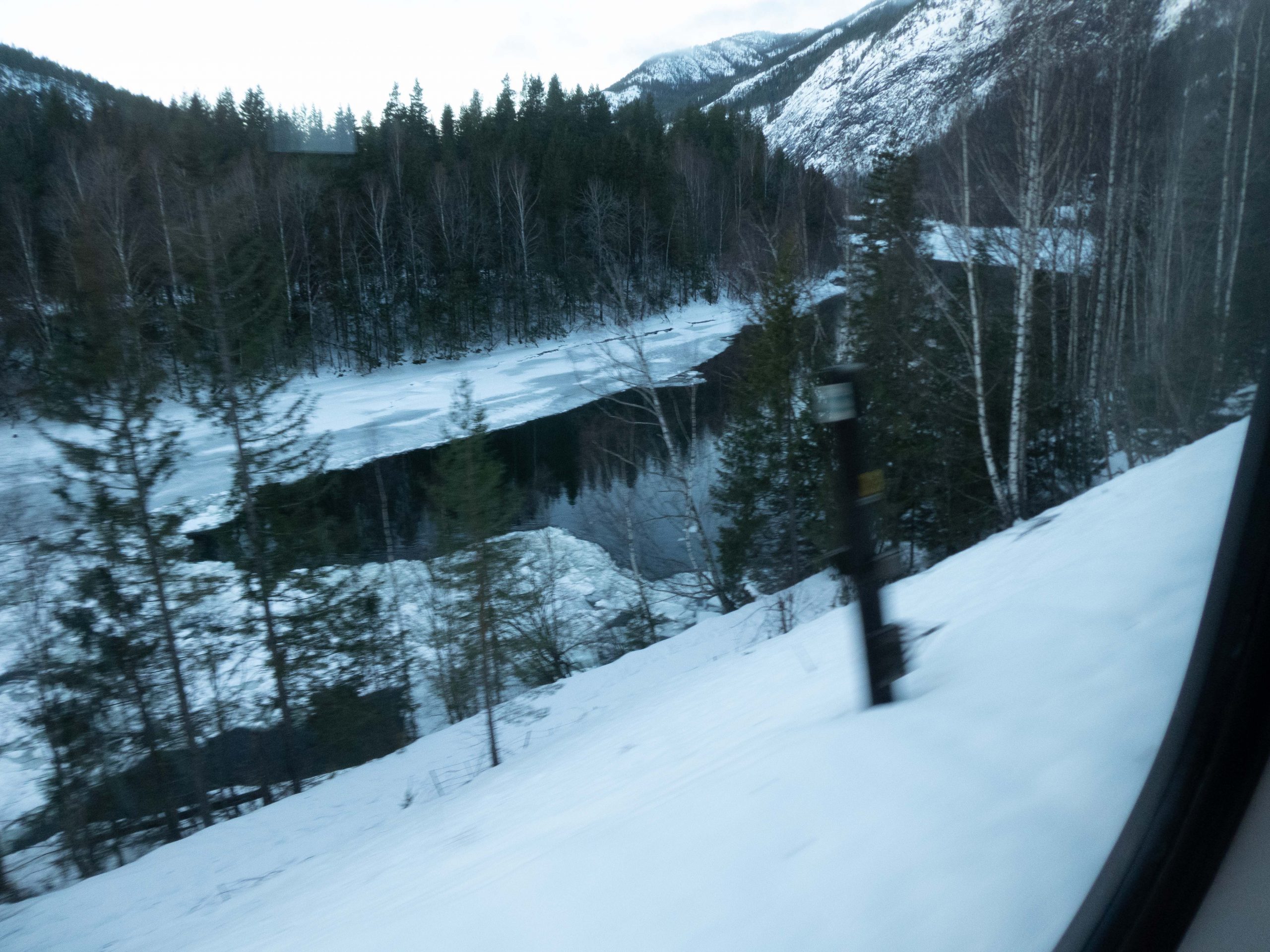


… up through Fla and Nesbyen to Gol. The pattern of the trainline from Oslo to Gol thus resembles the Big Dipper in Ursa Major tilted slightly clockwise.
Although the lakes are smooth and ice hides much of the river flow, at one point we cross Hallingdalselva above a twist of rapids and see the mass and power of Norway’s abundant water. On one of the lakes clear of ice I see lots of swans floating in the distance but cannot keep my binoculars still enough to identify them. I am hoping to see other than the common to UK mute swans. There is not a lot of other bird life, but I have seen the occasional deer from the train.
From Gol, Hallingdalselva turns west and we follow it as it climbs slowly towards the high tops of the coastal mountain through Al, Geilo, Ustaoset, to Finse, at 1,222m (4,009ft) the highest station in Norway, as darkness falls. The high plateau in the falling dusk with its long valleys and higher ridges away in the distance is a dreamy space.


We pass Myrdal, from which a popular short railway drops down to Flam on the shore of a deep sea fjord that starts north of Bergen. I will consider taking that on my way back, as well as staying a night at the hotel at Finse.
We get to Bergen at 19.30, and I wander through the centre of this buzzing city to my hotel where I set about completely reorganising my room so I can work at the desk with my computer plugged in. It looks much better as a result.
Breakfast next morning is a treat. I focus on the oatmeal with berries which is so good (why doesn’t my porridge taste like this?) so I ask the chef for the recipe. Apparently he adds a small amount of vanilla sugar, cinnamon, milk and a bit of yoghurt to the oatmeal in the evening and leaves it over night.
The hotel has an arrangement with a well-equipped local gym so I take advantage of that too – going beyond just stretches to a circuit of excellent machines. If I’d been doing this all my life, I’d be a different man!
The rest of the day is catching up, getting a haircut and getting ready for tomorrow when I join the ship.
Saturday 14th January – Cruise day 1 of 12
Use the gym, buy a map, not a lot else, go to boat around 17.30. Settle into cabin 332 – third deck, port side, with a porthole. Presumably the cabins on the starboard sife have a starboardhole. Have supper – excellent food. Explore boat – old fashioned and confusing to find my way around. Boat leaves at 20.30. Watch Bergen recede into the distance. I’m feeling oddly unsettled. There is a briefing at 21.30 where we are introduced to the Captain, the Chief Engineer, the Hospitality Manager, the head Chef, the Tourism leader – who will give us a briefing each night. We are told this is a sea voyage, the interest is the sea and what goes on around it, not a cruise, where the interest is in the entertainment laid on. I chat with an older British widow for a while.
Sunday 15th January – Cruise day 2 of 12
Sleeping badly so get up at 02.45 when we get to Floro, our first port of call, to watch what goes on. As well as taking tourists, this is a working ferry which carries post, cargo, and foot-passengers.

Back to bed and sleep fitfully, then deeply, waking just after 08.00 as we dock briefly in Torvik. I peer out of my cabin porthole and a sea eagle glides overhead. I do not have time to dress and get up to the deck to see more. However when I do go outside, I see a small flock of Eiders paddling towards us. They are such great birds and my first sea ducks of this trip and a joy.

Breakfast confirms that the food is going to be one of the highlights of this trip. A friendly chef explains why the boiled eggs are sitting in two temperature controlled water baths. However I go for other things. Potatoes, fried rough cut mixed veg, and baked beans seem to be a welcome standard offering in Norway, along with fruit, a ginger laden vitamin power shot, a mixed berry power shot, breads, jams, pastries, salads and pickles – plus lots of carnivore options.
At 09.45 we arrive into Alesund which we will leave at 20.00 this evening – our longest period in a port. In summer the ship would head off down a fjord for the day, but this is winter so it doesn’t, probably because there are not the extra paid tourist activities to support it.


I eschew the organised excursions and go for a walk, up through a park with a statue of a rather camp looking Viking, up to a viewpoint, 5kms down a ridge behind, watch out for the dog park where I have to take a side path that drops down to sea level, and follow another path back to the camp Viking. I have some very nice chats with people along the way including a young woman who has recently started a scince education job at the Alesund Aquarium who I meet for a second time at a beautifully situated picnic bench on the sea shore. I scan the water with my binoculars and see a distant group of sea ducks, possibly tufted duck (I’m missing my bird book 🙁 ), cormorants, and various gulls – black-backed and herring possibly.


Then I walk around Alesund’s (slightly disappointing) Art Deco centre – a result of a fire in 1904 which wiped out most of the wooden building down town and allowed the good people of Alesund to rebuild using the latest in archetectural style. And then back to the boat.


I’ve overdone it a bit and my back and right leg hurt so I have a hot shower, wash some clothes (for the first time since leaving UK) and take to my bed for a rest before supper.
Supper is the only meal of the day with set tables. I know I’ve been allocated a table for four and am slightly apprehensive about who I’ll be sharing with. It turns out it is only to be three of us: myself, Richard and Nick, a gay couple recently moved to Cornwall. This trip is Nick’s delayed by covid 70th birthday present to Richard. Richard is an actor, just finished nine weeks in pantomime in Hereford. Nick also works in theatre, including directing and teaching. He also sails and they have a boat – Richard pulling ropes when he is told and cooking. They are good company. I’m lucky.
Monday 16th January – Cruise day 3 of 12 – Trondheim
Overnight I dream that I am in a play but keep forgetting to learn my lines. I assume I’ll miraculously be able to know them. But there is also something sinister but curiously intriguing afoot in the real life around the play, and it is all about to reveal itself when I wake up. I mention this to Richard when I bump into him and he tells me that actors are bedeviled by these sorts of dreams and a range of others. I seem to remember having veterinary anxiety dreams early on too.
After breakfast we dock in Trondheim, and it is snowing.

It feels like a proper winter day! We are here only three hours, which is too short. I remember in 2008 walking up to the castle …

… and then down via the cathedral and back through the town to the boat, but I am not confident I have the time for all that today. Instead I have a series of enjoyable conversations.

I am so struck by the strong image in an advertisement that I feel obliged to go into the railway station, which it sits outside, to ask about it. It turns out it is for a green energy company. Apparently all Norwegian electricity is generated by water. They’ve certainly got enough. And a small population. Lucky them. The woman I am asking thinks they are using famous Norwegian athletes (she points out a female boxer in an advert on another wall), but I think the woman in the picture must also work on a goat farm or something like that, otherwise it would just be too odd.
I take the opportunity to ask more about the Norwegian rail network, which goes all the way up to Bodo and has been electrified as far as Trondheim. By chance while we are having this conversation, a lightbox of revolving advertisements nearby shows one with a picture of a musk ox. So I ask about musk ox in Norway, and my desire to see if their babies play like the kids of other types of goats (Musk Ox being apparently in the goat family) and she tells me they are in the Dovrefjell-Sunndalsfjell National Park (and probably Rondane National Park) near Dombas, just south of Trondheim.
I continue on my way and stop a passerby to check if I am on the right track for the art museum, starting by asking if she speaks English. She tells me she studied English in England when she was young, stayed in England for seven years, married an Englishman, and only left when he turned violent. We talk for a while and I tell her about my earlier conversation. It turns out she is now a teacher and has taken groups of young children to watch musk ox in the National Parks and that she once made a mistake by getting between a mother musk ox and her baby! This was apparenty in the autumn and she thinks they have their babies in the spring. Already I am thinking about a future trip, but first I will need to do a bit more background research.
I continue my walk. Trondheim has some great sculptures in its streets …


… and quirky old shops …

… as well as the usual churches / cathedrals …


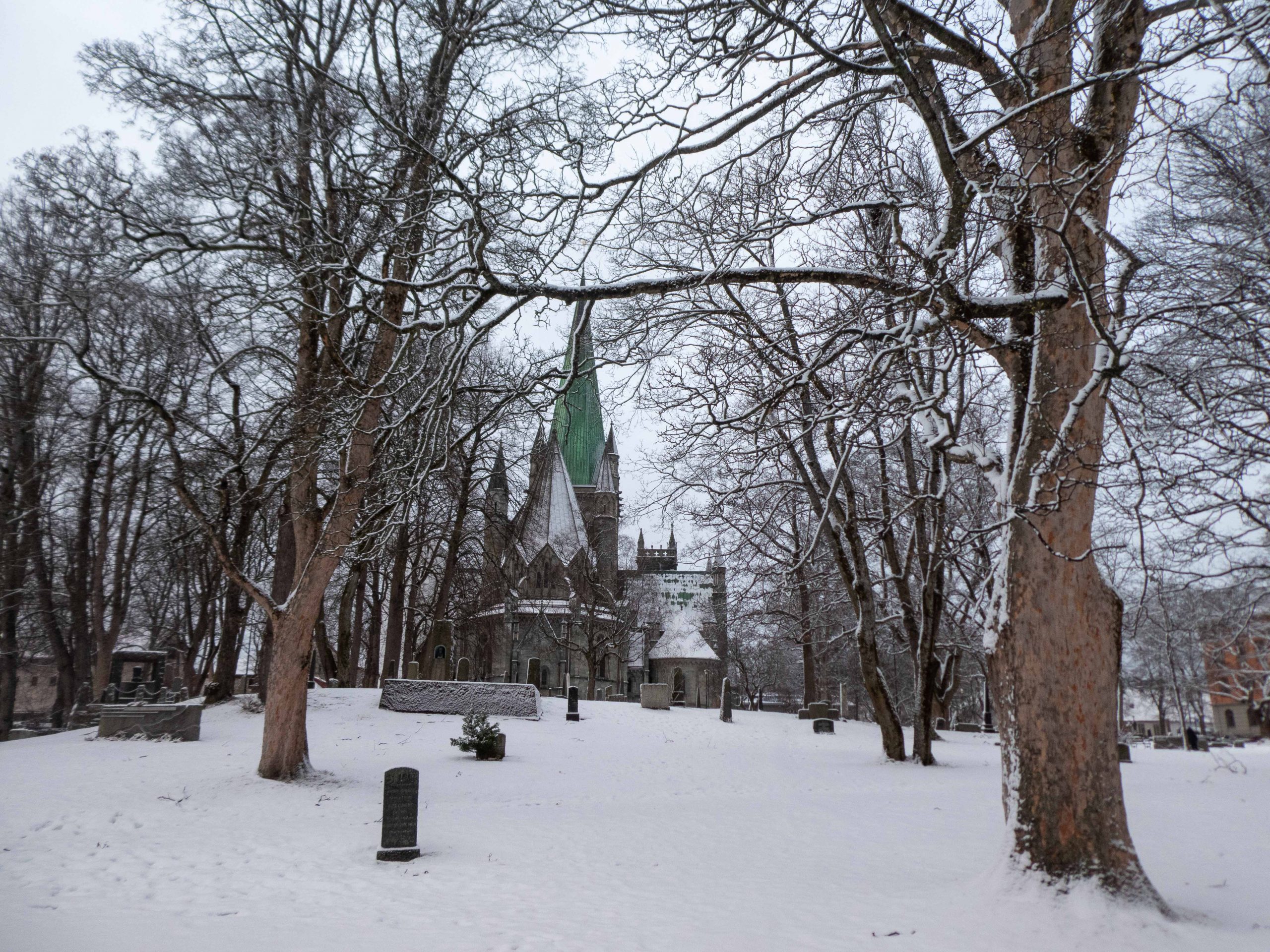
… and I call in at the cathedral, because I am trying to find the art gallery which I know is nearby, and have a good conversation with the woman checking tickets who tells me Nidaros is the first and largest cathedral in Norway, started by King Olaf II, the Viking who enforced Christianity as the only religion in Norway and so became its patron saint. He’s spent time in England helping the Vikings in northern England, yet he introduced the Catholic rather than the Celtic church. Apparently the Norwegians are now starting to question just how saintly he was in doing these things (and not before time in my opinion).

I stop at a cafe within a delightful wooden building by the river, a pilgrimage centre it turns out, for a hot chocolate and a piece of a tradional Norwegian nut cake. It is laid out like an old ashioned front room, is (unusually for Trondheim) dog friendly, and there is a very friendly English setter …


… before returning to the ship down one of the old canals lined with Hansa warehouses. Back at the ship I ask the man checking us in about Norway and WW2 – a subject too big to summarise here! And soon we set off again, saying goodbye to Trondheim, to another flotilla of Eider ducks …


… and passing Munkholmen, ‘an island that has a rich history and has been a place of execution, monastery, fortress and prison, and which is today a popular tourist destination’ (according to our daily briefing paper), on our way out through Trondheimfjord.

Later in the afternoon we pass the Kjeungskjaer Lighthouse which looks like a tall octagonal house in maroon brick. In writing this from the notes we are given each day, I see the German for lighthouse is leuchtturm!


Tuesday 17th January – Cruise day 4 of 12 – Arctic Circle, Bodo and Saltstraumen
A lot to catch up on in the several days since my last post!
Bergen is roughly level with the Shetland Islands, and today early in the morning just south of Bodo, we cross the arctic circle. Later in the morning there is a celebration ceremony on deck during which everyone who wants to can get a cube of ice put down their backs in exchange for a snifter of spirits and a certificate. Richard and Nick who went through the ice discomfort were further discomfited to find just anyone (eg myself who somehow failed to register that the event was taking place) could pick up a certificate from the pile left with the day notes.

In the afternoon we arrive in Bodo where we stop for about 2h 15m and I go on my first official excursion to see Saltstraumen about 20kms south. This is supposedly the fastest tidal race in the world in the narrow channel between the open sea and Skjerstad Fjord. The huge volume of water trying to pass between sea and fjord each time the tide turns sets up a cascade of eddies and whirlpools down each side of the channel. The spectacle ranges from complete calm at the turn of the tide to a churning flow of beading whirlpools at the peaks of the spring tides. While not at its peak today, it is still a powerful spectacle.
Because the churn brings fish and other sea life to the surface, Saltstraumen attracts birds, though of ducks only Eiders are powerful enough to dive safely into it. We were greeted by two Sea Eagles overhead, a few gulls, and a small flotilla of Eiders which obligingly dive for us.
Apologies for my interjections on that second video, they look like vulnerable juveniles to me. On the bus there and back are two surprisingly good information films presumably geo-referenced to things we pass on the way there, and on the way back, about the ecology around Saltstraumen. At some times of the year, the flotillas of Eiders have hundreds of birds. Apparently in the past, at its wildest, Saltstraumen would leave large fish washed up on the shores that could just be picked up, taken home and cooked. That seems to happen almost never now – too few fish in the sea.

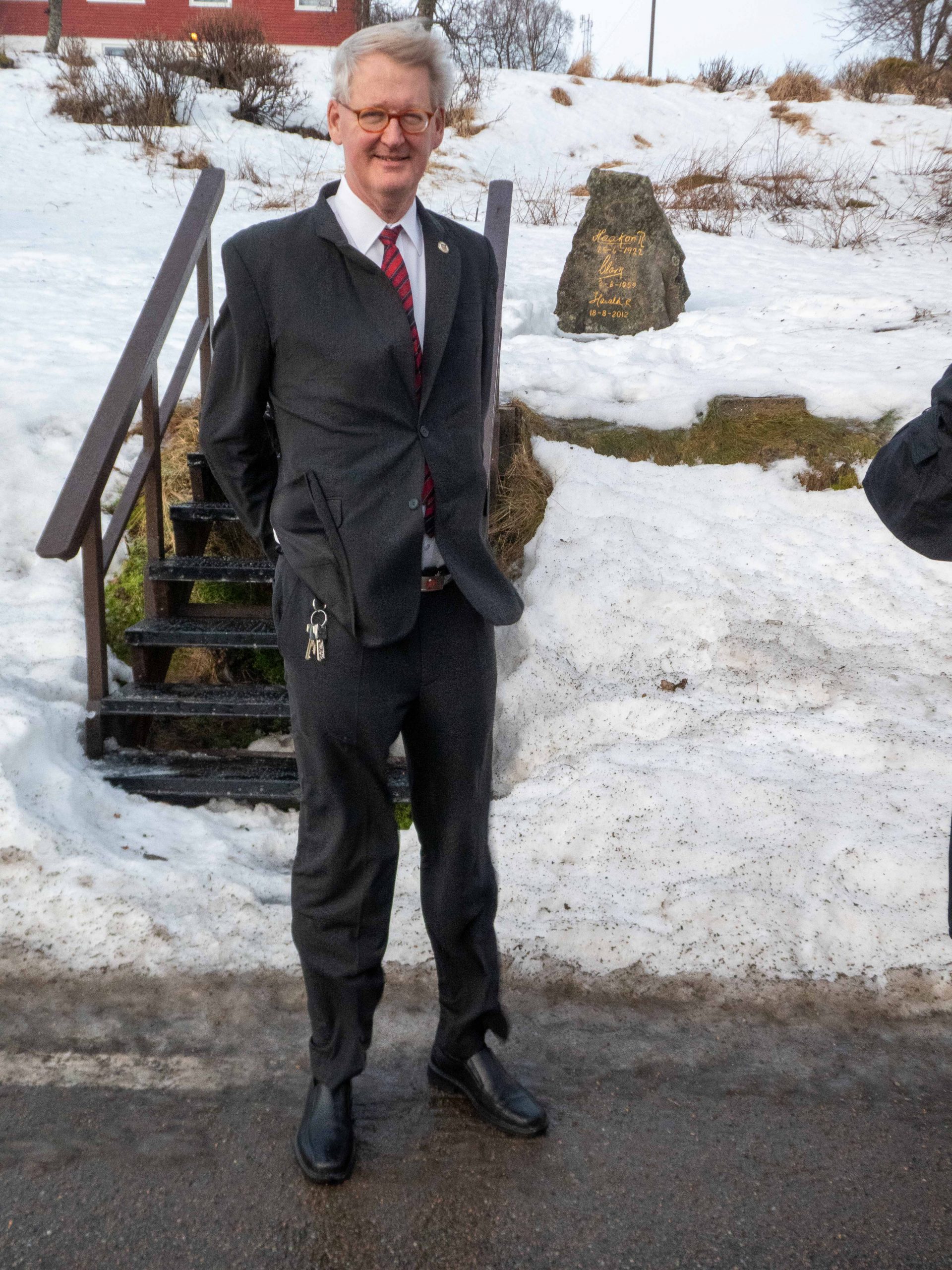
In the evening we call in at Svolvaer for about an hour and troupe off to a local art gallery to see the work of local artist (xxx name to be added later if I remember – Dagfinn Bakke!). We are led by Egbert, our head of tourism. He is very tall and thin so doesn’t have to carry a flag or umbrella as most tour leaders do, wears a light anorak over his normal office attire, and deals with the icy roads and pavements in his polished black office shoes. We, on the other hand are all dressed up in our polar explorer gear, crampons over our boots.
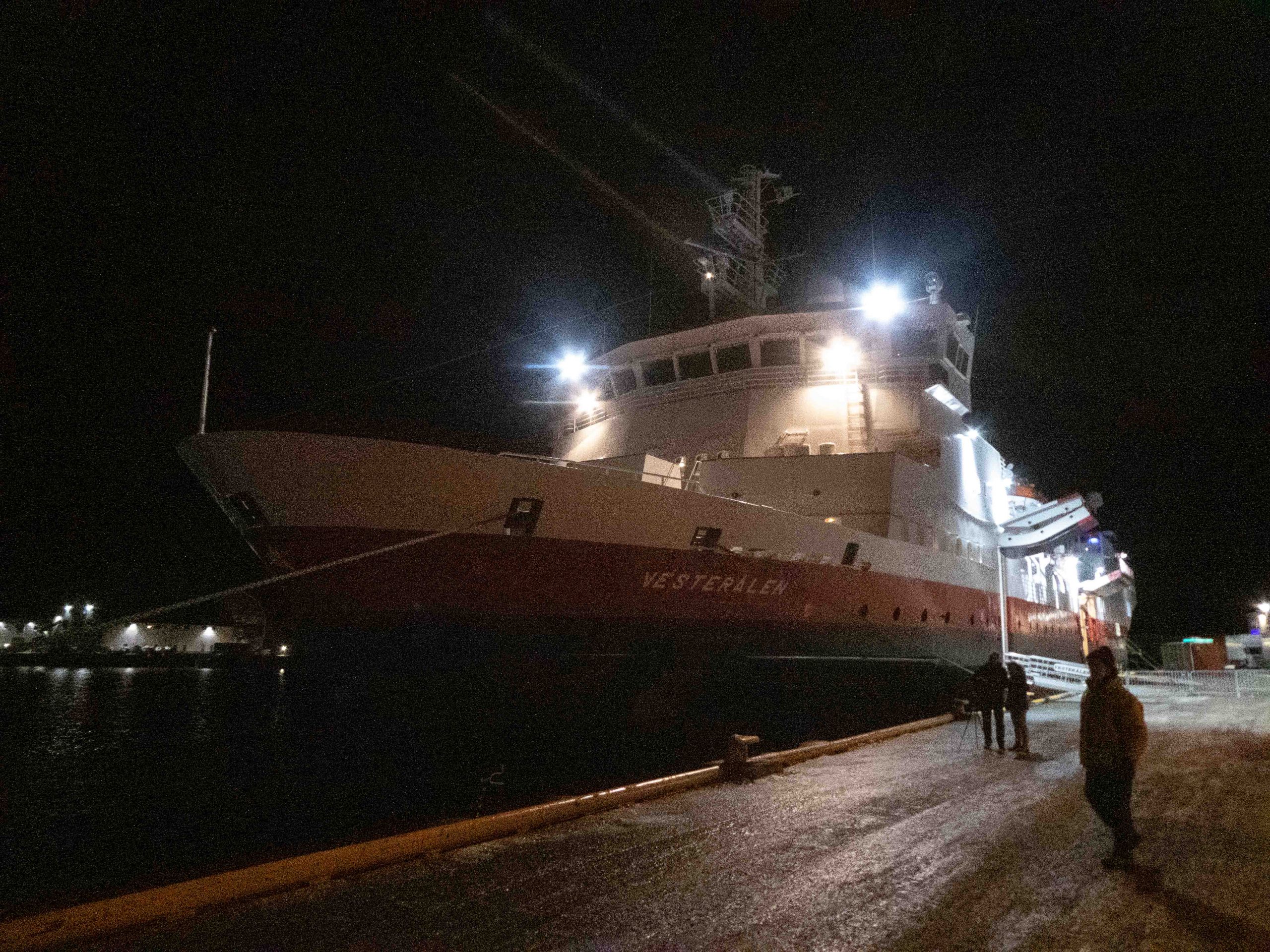
Note: The version of events described in this paragraph may not have happened. There has been disagreement among the passengers I talk to about how many times we have been called to see the northern lights. I’m with the three group, others say just two. The ship’s log seems to agree with the twoers, which is obviously irritating. In the middle of the evening the Northern Lights alert sounds for the first time and we all pile up on deck to be entranced. However there is little more than a smudge of what looks like cloud which quickly disperses. Some of the first few out on deck claim they think it looked green and the photos confirm this. We learn that the photos tend to look better than what is seen by the naked eye. There is muttering that this means the Hurtigruten pledge to give a free five day cruise if there are no sightings is now void.
Later still, around midnight, we pass Trollfjord, a dramatically deep narrow steep-sided fjord, setting for many iconic Hurtigruten marketing images. Midnight in mid-winter is not the time to go trolling up Trolfjord, so Vesteralen backs its stern up, shines its spotlight, while we all mill about on deck drinking punch out of little enamel Trollfjord mugs we have all bought for the purpose. My camera gallantly tries to capture the scene, but all that comes out is a circle of spotlit rock hanging like a moon in the darkness.
Wednesday 18th January – Cruise day 5 of 12 – Finnsnes & Tromso
Our short stop in Finnsnes is preceded by a short introduction from Egbert who tells us that when he first started his job, he researched everywhere the Hurtigruten ships stop, and the only place that seemed to have absolutely nothing interesting about it was Finnsnes.

Well, Nick had looked Finnsnes up on line and found it meant ‘existing’ which seems interesting enough, particularly for a place with so little interest that it might be considered to be merely existing. So, within the limits of our 30 minute visit, I set out to find something interesting, and to my suprise, not five minutes from the boat is a statue to the visionary Ottar who among other things seems to have been the first person to call his country Norway to a foreigner (see photo below for details).


Once back on the boat, I mention all these interesting things about Finnsnes to Egbert who tells me the town name Finnsnes means a spit of land settled by Finns or possibly Sami, and is etymologically completely unrelated to the word for existing, and there seems to be little historical evidence that Ottar had any close association to Finnsnes (despite what Finnsnes thinks). On top of that, the cafe with the lovely advertisement for hot chocolate on its outside is not open. Nevertheless I enjoy my short visit to Finnsnes which feels a comfortable little town.
Most nights Egbert gives a talk of some sort, and the most interesting up to now has been about the treatment of the Sami people, which was as bad under the enlightened Social Democrat Norwegian administration after 1945, with enforced seperation of children from thier parents so that they could grow up good homogenous Norwegians. This only stopped when other European nations pointed out the hypocrisy of Norwegian People’s Aid, hugely influential in international development, fighting against this sort of abuse in Africa.
Later in the afternoon we have four hours in Tromso, ‘Norway’s capital of the north’. With Bill, a fellow passenger whose travel companion is feeling ill, we visit the statue of Roald Amundsen, the first man to reach the north and south poles …

… on our way to the Polar Museum to learn more about Roald and Fridtjof Nansen, another towering figure in polar exploration. Bill works in the education department of the Scarborough museum so it is interesting to get his take on the way the place is laid out. Most of the museum is about hunting – the main reason people visited the arctic – and to my surprise we find a number of Musk Ox references as it seems they were introduced to Svalbard, then hunted out.

Afterwards we cross the harbour bridge to get a closer look at the ‘Arctic Cathedral’ …

… before returning to the ship and heading off into the night.
Thursday 19th January – Cruise day 6 of 12 – Honningsvag
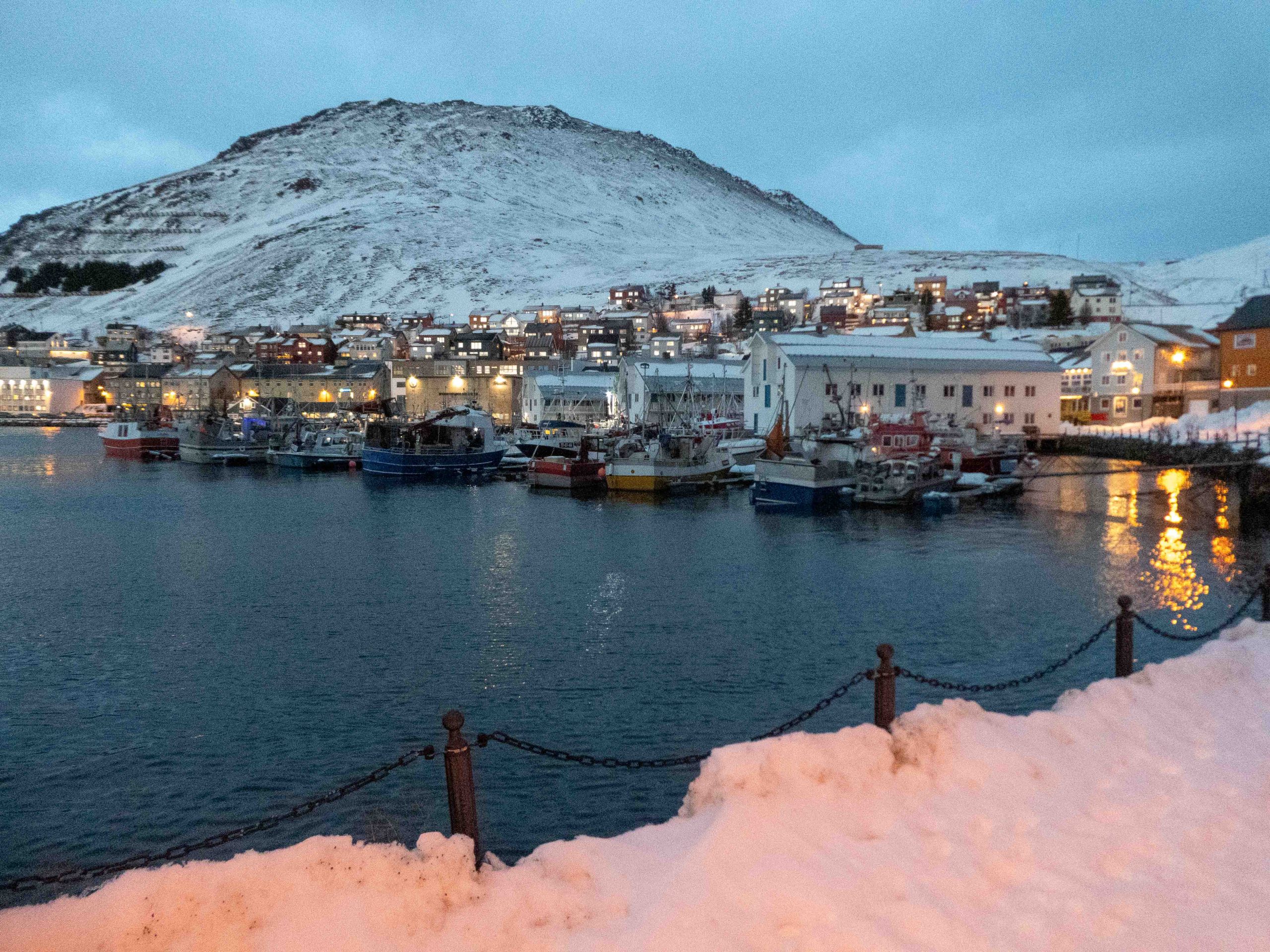
The highlight of today’s voyage is three hours and thirty minutes in Honningsvag. Some take a coach to North Cape, the most northerly point in Norway. Having visited it with my parents mid-summer in 2008, I choose this time to walk around town. I chance upon the Tourist Information office where a young Russian man explains what to see. We also discuss politics briefly and his hopes for a brighter Russian future. Following his suggestion I wend my way up through town popping in to some local craft shops before heading on up to a viewpoint part way up the hill above Honningsvag.


An information board shows all the hikes possible in the summer but I stop at the iced up steps that lead to the summit and the ridge beyond, enjoy the view for a while before dropping back to the ship taking a wide circuit to the outer suburbs (of this small community) and back as close to the shore as I can get and the fishing boat harbour with some lovely old wooden warehouse buildings.

Finally I call into the local museum which sits at the docks by the ship and learn about the German occupation and retreat from north Norway. The church is the only building dating back before 1944 as it was the only building spared when the Germans, who had occupied Norway from 1941, retreated with a brutally enforced scorched earth policy destroying all infrastructure that could be of use to the liberating Russian army and evacuation of all inhabitants to the south of Norway.
I also see the following two small insights into past events …


… and I cannot help wondering what hapenend to the penguins. As for the witches, more insight comes in Vardo.
Tonight is also, sadly, my last supper (on Vesteralen but I hope not in life) with Richard and Nick who will leave the boat in Kirkenes tomorrow to fly home to Cornwall. The ship has been a friendly place with lots of interesting people exchanging information and passing the time together, and Richard and Nick have been a large part of this. We are all hoping for a good display of the Northern Lights to see them off …
Now we have two possible versions of events. The one I’d like to believe is …
… and, although it isn’t a huge spectacle, we do see a far more convincing show than the other night.
but it may be what I’ve said in the blog about another night, ie …
In the middle of the evening the Northern Lights alert sounds for the first time and we all pile up on deck to be entranced. However there is little more than a smudge of what looks like cloud which quickly disperses. Some of the first few out on deck claim they think it looked green and the photos confirm this. We learn that the photos tend to look better than what is seen by the naked eye. There is muttering that this means the Hurtigruten pledge to give a free five day cruise if there are no sightings is now void.
Either way I have had the opportunity to discover that neither my camera nor phone are likely to get any decent photos of an Aurora so I may as well just enjoy the show if it happens again.
Interlude: a few general notes, comments and observations
This sea voyaging life has a number of guiding rhythms. Most of the time the boat is moving and the Norwegian coast slowly passes with its strong cleanly defined mountains, cliffs, rock outcrops, more so now that snow and rock combine in black and white. I want to be watching all of it unfold, to understand how a country so long and thin and spread out, how society and all its little communites, works. The geography, topography, how all the fjords interconnect, and how the health of the wider ecosystem is holding up. I have seen very little wildlife, just gulls in small groups, hooded crows in large numbers near towns, rafts of eider duck, a few other unidentified sea ducks, cormorants, the odd grey heron, swans (mute is turns out, the most likely species) and three sea eagles. Occasional small flocks of small birds flit by unidentifiable. In towns a few people put out bird food and then it is a delight to see blue/great tits (too fleeting and I often get confused) and sparrows. Reflecting on this and reading that we are visiting towns as far north as any in Siberia and northern Canada, I wonder if the birds from here are currently down in the UK at places like the Exe estuary.
The further north we have gone, the more the night-day cycle is disrupted. Night is long and day is a long dawn that merges slowly into a long dusk. Day is not as short and dark as I’d thought. It would be interesting to experience the solstice darkness. Ports pop up as frequent but irregular way points. In some we stay 10 or 15 minutes, in others we may stay several hours. At some there are organised excursions – there is a whole book of them – and they range from following Egbert (dressed in office attire, perhaps with a light anorak) to a nearby point of interest, through to a boat, snow-mobile, or bus trip of several hours, perhaps rejoining the ship at a different port. There are occasional on deck activities involving a drink or bit of food, sometimes relating to things on shore, sometimes following their own logic. And activities can affect meal routines slightly. Breakfast and lunch are always free-seating buffets, dinner is mostly set seating with a served menu with three choices, one vegan, for each of three courses. The food remains excellent. I was told the trend is that in the first few days, passengers eat like gluttons as the buffets are so good, but by about day five slow down to more normal levels of consumption. Certainly I have become less of a glutton.
The quirky Vesteralen has become much more familiar over the last week. Unlike the newer ships which seem to have full decks on every level, Vesteralen has a distinct poop deck above the stern, and a long panoramic observation room which looks lifted into place by crane to fill a space behind the bridge as far as the gap before the poop. She has three stairwells, front, middle and back, and a lift which I haven’t yet used, all of which seem to have a different deck range. A recent revelation is a point of egress leading for’ard to a little balcony deck that wraps around the for’ard saloon. I can now stand and watch where we are going, and watch the crew dealing with the ropes when we arrive and leave port. Few people seem to know about this, which is better for those of us who do.
I am now reasonably confident about making my way around the passenger spaces, but of course there is parallel world of crew spaces and it is a strange thrill when the boat-side staff appear from unnoticed hatches and doorways and wander with confident friendly purpose individually or in small groups within the passenger spaces. I chat to the crew when I get a chance so am gradually learning a bit more about the workings of the ship. Most of the crew are Norwegian but a few come from elsewhere, and likely more in future as it seems to be difficult to attract the numbers of new crew that are needed.
What helped me finally get to grips with the ship’s layout was realising only a couple of days ago that my cabin is not to port but to starboard! Not unexpectedly this untwisted a contortion my brain had been struggling with. Yet I do still have a porthole.
Hurtigruten ships toot at each other as they pass and these passings are announced over the loudspeakers so we can all go and look and wave if we want.
Friday 20th January – Cruise day 7 of 12 – Kirkenes, Vardo and the Northern Lights!
We arrive at Kirkenes, the furthest port in our voyage, at 09.00 and will be here till 12.30. Richard and Nick leave with a lot of others, and apparently the same number of new passengers get on, unusually balanced. Many of the new people are a group of Turkish travellers, some with children, so there is a different feel to the ship now.
There are many excursions from Kirkenes too, but once again I choose just to wander around the town.

There is a waiting room / shop / information place just by where the ship berths so I call in there for a map of the town, and find the female officer, a strong handsome woman, having a blazing row with a similarly sized solid well turned out working man. It looks fascinatingly personal. He leaves (probably a result of my hanging around) and I ask if she is ok. It turns out she is Russian, he is Ukrainian. He has lived and worked in Russia and on a Russian trawler for years, and has completely bought into Russian media propaganda about the war. It is a strange situation with the Russian supporting Ukraine, the Ukrainian Russia. She tries to reason with him, challenging his stories and statistics, but to no avail. I get the impression they have spoken to each other before. She tells me more about the relationship between Russian trawlers and Norwegian ports and the reasons why Russian trawlers base themselves in Norway but the details are beyond me and anyway I cannot check any of the facts myself. She also tells me that she lives in the forest at the edge of Kirkenes where moose roam free. I’d love to see moose. Instead I take her advice about where to go and what to see in Kirkenes, most interestingly a display in the town square of photos from the early 1900s …
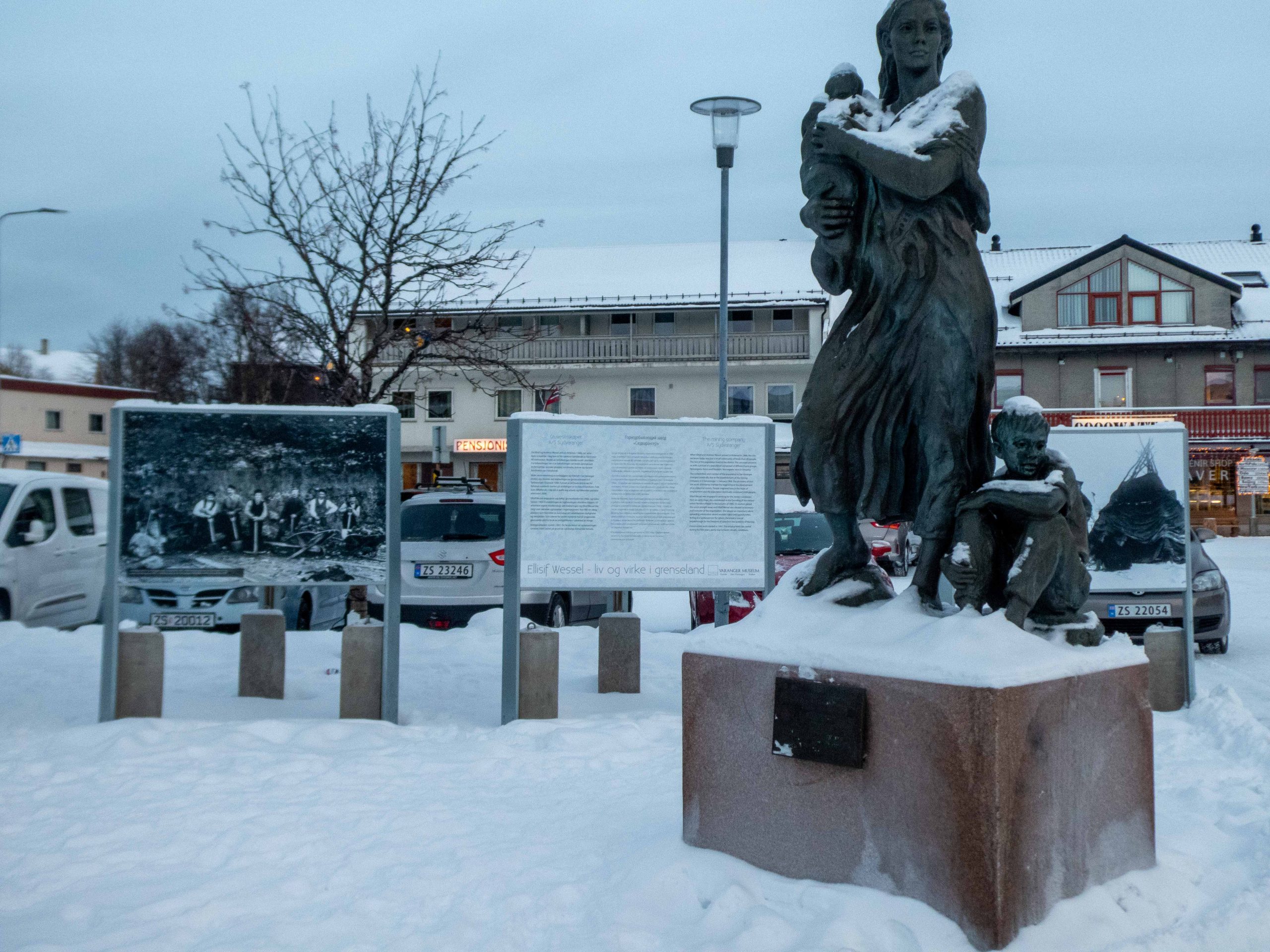


… taken and developed by a socially active woman who came up with her husband who had just been appointed community doctor – an inspiring couple.

Kirkenes is also famous for the Kamchatka king crabs found in the adjacent Varangerfjord, Norway’s largest fjord. I imagine they must look something like the one above. Below are other sights from Kirkenes.


In my wandering, as in Honningsvag, I see an occasional bird feeder and it is then a delight and a surprise to see sparrows and great tits dotting about in the bushes nearby.


I return to the ship …

… we leave Kirkenes and start our return to Bergen.
Around 16.00 we stop at Vardo for an hour. As we are waiting to leave the ship I get talking with one of the friendly Able Seamen who is waiting with us not, it turns out, to go to the fort like us, but to visit a church at the centre of yet another 1600s witch burning frenzy. Then the drawbridge is down and Egbert leads a large group of us to Vardohus fort, which I remember from before. While the others mill about in the fort courtyard and visit the historical display rooms, I go up onto the battlements, treading cautiously over treacherous ice. It is nice to have peace and quiet and to look around and up at the sky. Long cloudy streaks are coming out of the far horizon splitting and curving like sea kelp. There is no colour but they look like they could be Northern Lights. I watch for a while and then go gingerly back down and ask Egbert how you can tell between clouds and Northern Lights. He takes a quick look up from the lit coutyard and says it is too cloudy, you cannot see the stars so it won’t be the Northern Lights. We finish off at the fort and all head back to the ship in time for dinner. The Able Seaman finds me and gives me a small booklet on the witch burnings in English that he very kindly got for me. It is grim reading. A little later afterwards, I bump into Egbert and he tells me that I probably had seen the Northern Lights because a colleague off the ship was also in town and saw them. Obviously I’m pleased and wonder if the Able Seaman was the colleague.

Later in the evening the Northern Lights alarm goes off again and we all pile back out on deck and this time it is the full on display, building up, remaining intense for a long while, then slowly fading down, over about 90 minutes or even longer. They are miles up in the atmosphere, higher than the highest clouds, so they have the same clean pure ephemerality as cirrostratus but move and shift shape in vertical drapes. However, again with the naked eye there is little or no colour but those with good cameras came away with some lovely images. I start on the upper deck but move to the front balcony where I am with only one or two others. It is well past midnight when I get to bed. A good evening.
Saturday 21th January – Cruise day 8 of 12 – Hammerfest
Our voyage is going to seem faster as we retrace the line of our boat wake back towards Bergen.

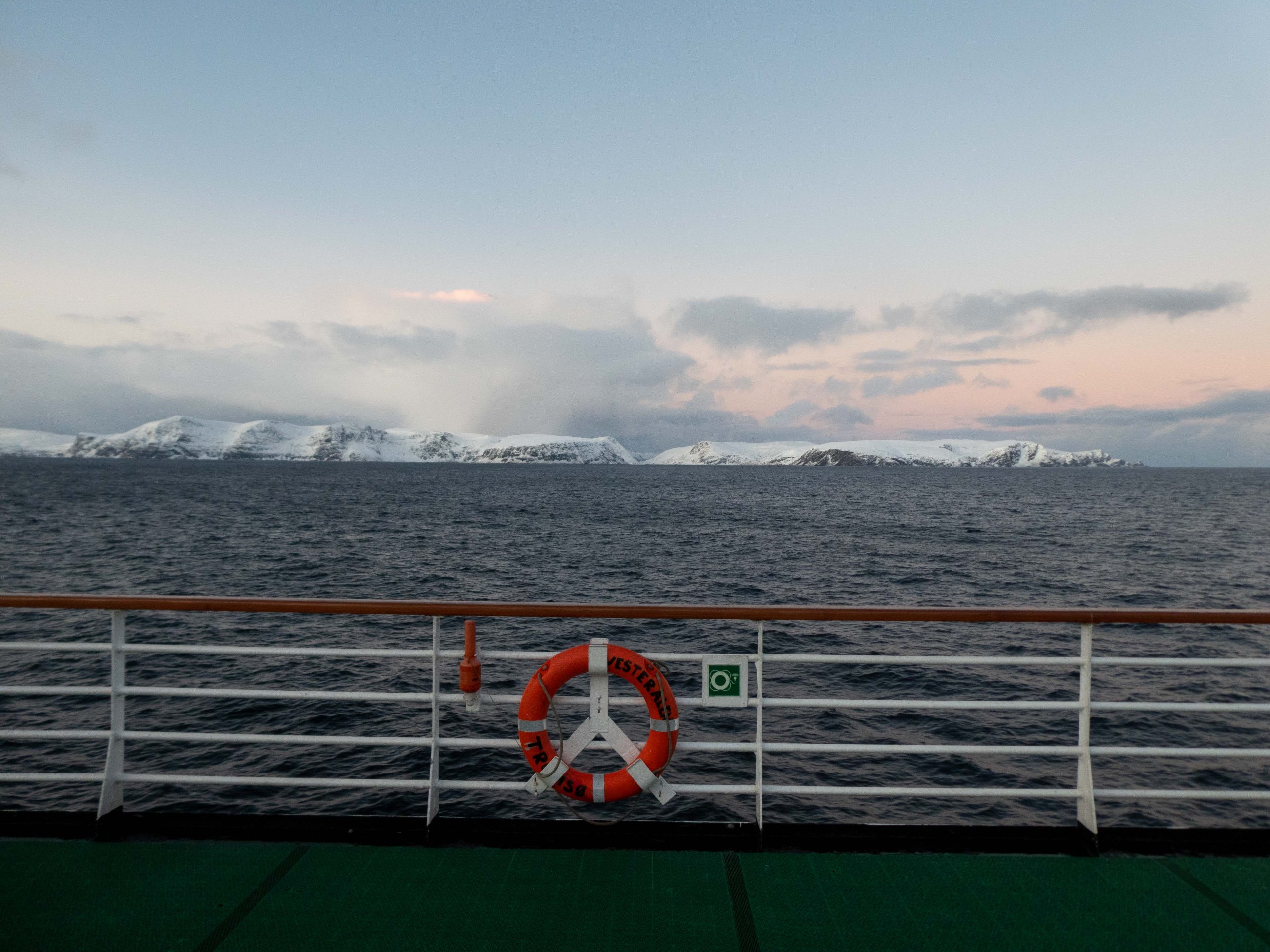


We gather on deck to drink strong coffee, ‘energy coffee’, as we pass Melkoya …


… part of the Snohvit project, opened in 2007 and Europe’s first plant for the export of liquified natural gas which sits just outside Hammerfest. There we dock for nearly two hours and follow Egbert to the Meridian Pillar.


This is one of a chain of physical geolocation points that stretch north to south across Europe in a fairly straight line. Among other things they have helped confirm Newton’s prediction that the Earth is not a true sphere, but flattened at the poles. Though apparently the difference between the equatorial circumference of the earth and the meridional circumference is only 41 miles!

The rest of the day is on the boat and Egbert gives two talks. The first is on Trolls with the take home message: they were a rural folk tale fabrication of the 19th Century arts and crafts back to nature kick back against industrialisation movement – or something. The second is about the good ship Vesteralen.
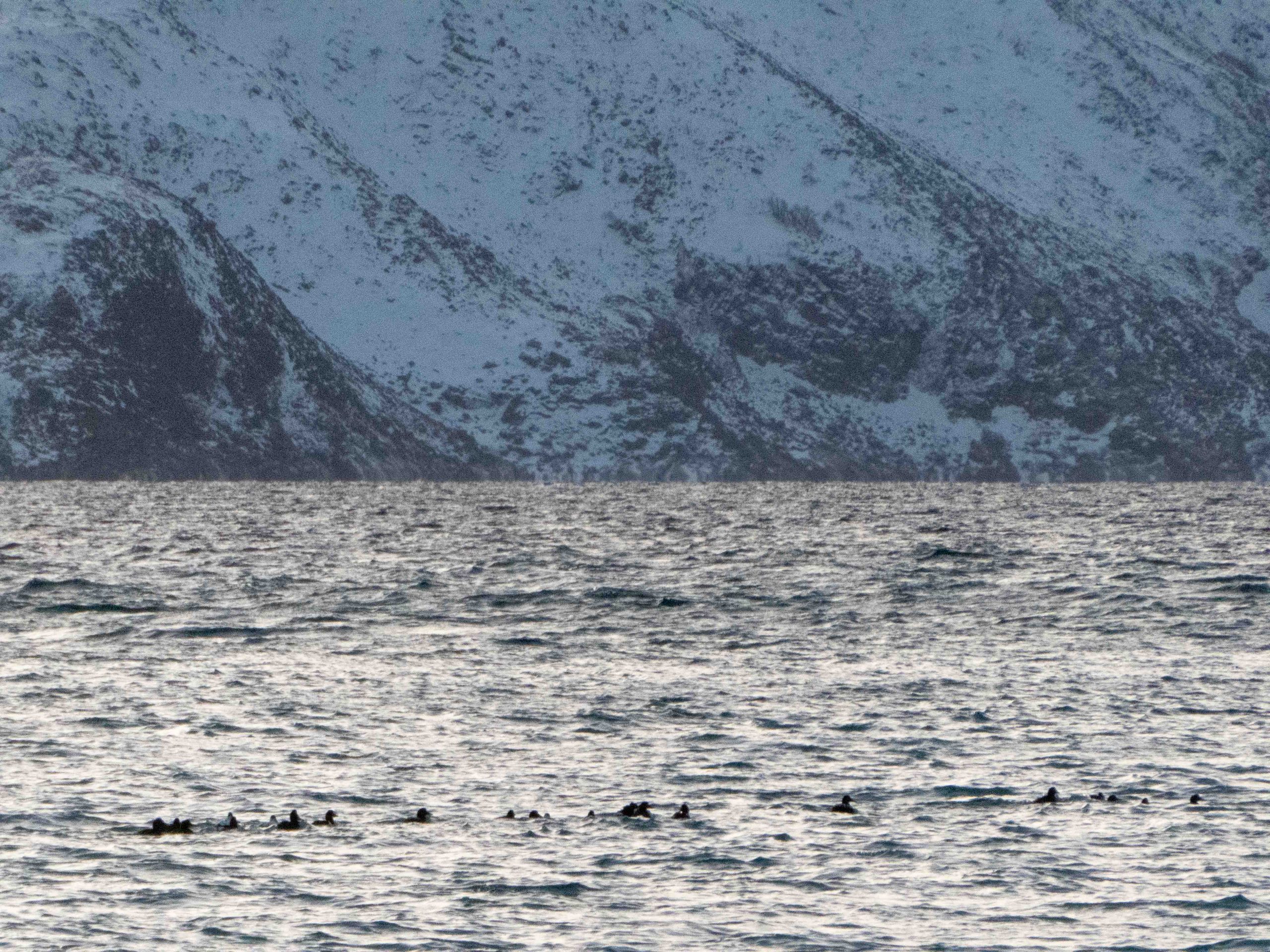

Sunday 22nd January – Cruise day 9 of 12 – a stormy day and Stokmarknes

Early in the day some excurtionists get off at Harstad believing they will have a leisurely coach ride across to Sortland via a ferry on which they would have coffee and cakes. Unfortunately the day is stormy, the ferry is cancelled, so they are driven very fast a very long way round to Sortland but enjoy themselves regardless and make it back to the boat on time.


The rest of us stay on board watching stunning scenery with outriders of the coming storm adding drama to the skyscape.


When we stop at Sortland, Egbert leads us to the three kings stone – a stone signed by three kings, a bit like a visitors’ book, I think.


In the afternoon we stop at Stokmarknes for a couple of hours for a wander and a quick look round the Hurtigruten museum which is mainly a gorgeous old ship all spruced up and shiny and delightfully stylish with a modern protective building put over it. Gentle plans to revisit Trollfjord and the stunning scenery that surrounds it in daylight have had to be shelved as the coming storm requires us to eat early so the food can all be cleared and we can be herded back to our cabins. The storm turns out not so bad and it is delightful to be rocked gently in our beds.
Monday 23rd January – Cruise day 10 of 12 – leaving the Arctic Circle, Sandnessjoen and Bronnoysund

I go outside onto the balcony early today so as not to miss the Arctic Circle marker as I did on the way up. The sea is still stormy but it is wonderful and the mountains along the shore among the highest and most dramatic. My photos don’t begin to do justice to the scenery we’ve been passing.


We stop late morning in Sandnessjoen for half an hour, long enough to visit two statues.


We stop again late afternoon in Bronnoysund for two and a half hours. It is raining heavily but we go for a walk. The others go back after an hour but I, protected by Paramo and enjoying the opportunity to stretch my legs, keep going. Losing concentration for a moment I find myself falling flat on my back, my head slamming down on the ice. There is that horrible feeling of potential harm, then the adrenaline kicks in and tells me I have to get back to the boat. I seem to have got off lightly though I anticipate a much sorer head and neck tomorrow. The staff on this boat are universally wonderful, though a few stand out for me. It is sad we are all soon to part ways.
Tuesday 24th January – Cruise day 11 of 12 – a song for Egbert and a surprise in Kristiansund
I am happy to find myself in surprisingly good shape this morning. Today anyway does not have much going on. Bill knows a song in Norwegian from his time with an LGB choir in Manchester which is about drinking coffee, with the chorus ‘do you want another cup of coffee?’ ‘yes, please’. So we decide to sing it to Egbert as a thank you for all his expeditions. We are unsure how he will respond. He asks us to wait while the Restaurant Manager joins us …
… and to our surprise he loves it, . After singing it, Bill explains he was taught it by an Englishman and would he happy for any tips on improving the Norwegian. ‘Oh, that was Norwegian,’ says Egbert, ‘I thought it was French’.
We voyage south in warm rain.
At 16.30 we arrive in Kristiansund for an hour. Egbert leads us out for the final time. As we straggle along behind him around the harbour basin, we realise that for the first time he has not told us where we are heading …

… so after about 500m, we are surprised to find ourselves being walked onto another boat …

… this time a small harbour ferry. We stream aboard feeling a bit like the band in Animal House led into a dead end where they mill about and fall over. Instead we are on what purports to be the oldest ferry in the world, and get a quick tour of the four corners of this prosperous little town. A fun final excursion.

Then it is back to Vesteralen for our final supper.
And a late walk when we stop in Molde at the end of the evening.

Wednesday 25th January – Cruise day 12 of 12 – back to Bergen
Around breakfast we pass the Stabben Fyr lighthouse …


… then through the rest of the morning and into the afternoon we are among the stark damp fjords and mountains that lead into Bergen.


It’s been a morning of last conversations with crew – including Astrid in the restaurant & Fred who works boatside – and with many fellow passengers. This has been an unexpectedly friendly and sociable escape, partly down to MS Vesteralen with her cosy, quirky, inside and out spaces. But all too soon we are in Bergen and leaving it all behind.
I walk back to the Augustin hotel. It too feels familiar with its friendly staff and I am glad I have a few days to process and readjust.
Bill flies home tomorrow but has some things left on his shopping list. So we meet and seek out Bergen’s vintage clothes shops in search of cheap but lovely old Norwegian wool pullovers. He is also after runes. We are unsuccessful on both counts but pass the smoking cigar – …

… which though probably not its real name, can smoke (or steam – I’m not sure which or how) though not tonight – a sculpture by the lead singer of Aha of ‘Take on me’ fame, who seems to be a man of many talents; and find the chocolate shop for a hot chocolate.
Thursday 26th January: Bergen and Grieg’s House


Bergen today is cold and sunny, the forecast ahead more bleak, so I take the opportuity to visit Grieg’s house by the water, about an hour away – airport tram from the city centre to Hop then a 20 min walk. The walk cuts through a plexus of transport infrastructure, road, rail, different sizes stacked up and criss-crossing, constrained by the tight geography of land and fjord. It is a touch icy in places and I am a touch fearful after my recent fall.
Bill visited Grieg’s house during his day in Bergen before joining the Vesteralen. He told me Grieg’s music had saved him when his interst in learning the piano was waning, being able to play the piano had helped start his primary school teaching career, and he continues to love Grieg’s music. The house is fascinating about Grieg’s place, alongside others, in relation to Norway’s emerging national identity in the late 1800s, but it is also a shrine to the love he shared with his wife. I go there partly to catch an echo of Bill’s emotional response to the place and when I start down to the jetty where Grieg and his wife are buried, I am joined by a flow of primary school children who seem to have materialised from nowhere. It feels oddly fitting. It also reminds me of Hetta and Alfie, my Od-daughter and her husband, also primary school teachers.
The house …


… sits atop an outcrop. Drop down one side for the jetty and burial place of Edvard and Nina Grieg …


… and a nesting box for blue and great tits – both of which I see dotting around in the bushes.


Drop down the other for Grieg’s composition hut.


Photographing the inside of the hut proves difficult but I like the odd results so am sharing them with you …


I return to Bergen and go up the funicular for a view that shows the extent of Bergen’s urban sprawl, which was also becoming apparent around Grieg’s house.

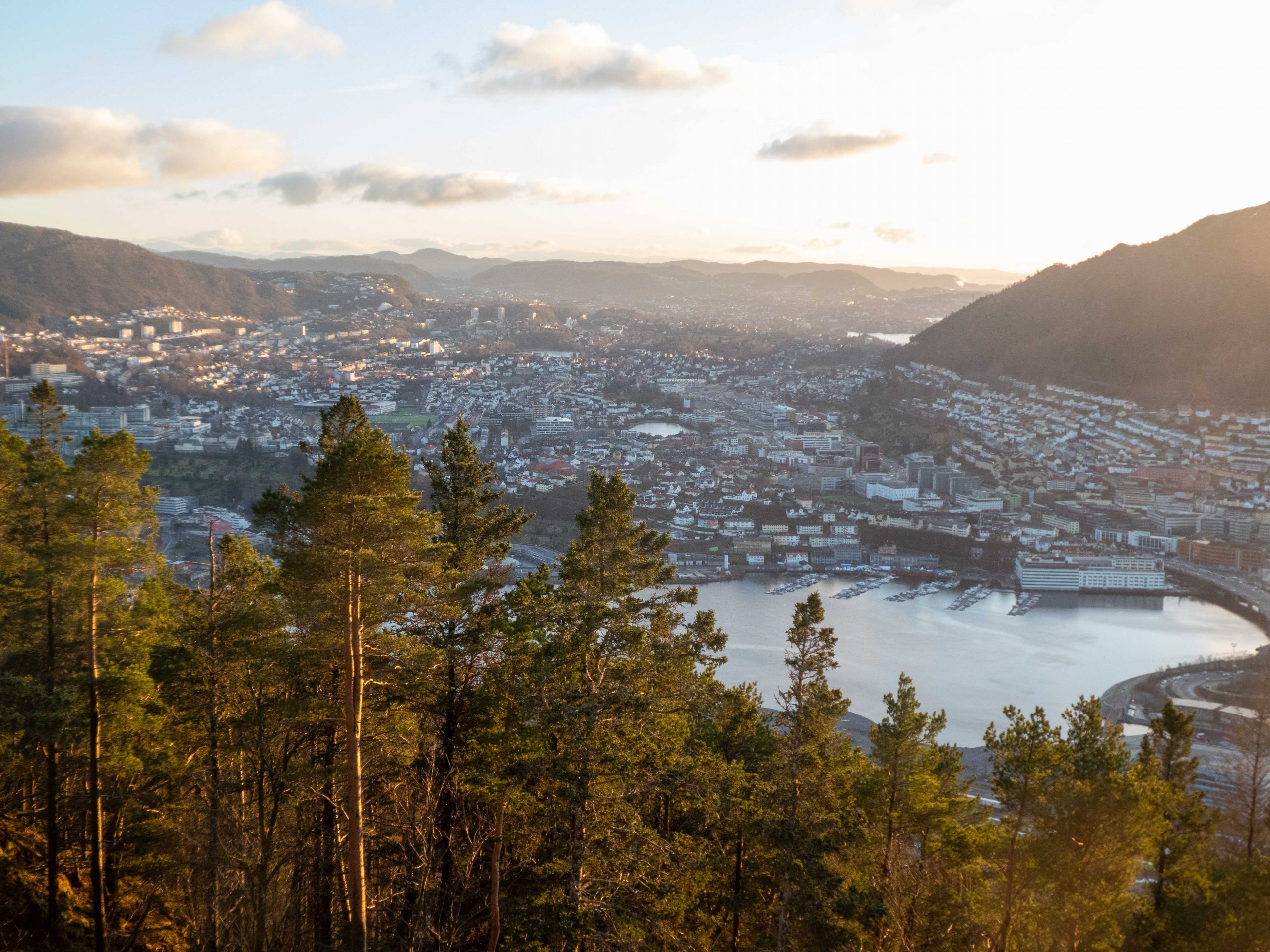

Some goats live up there …


There is also a rather wonderful tree house…
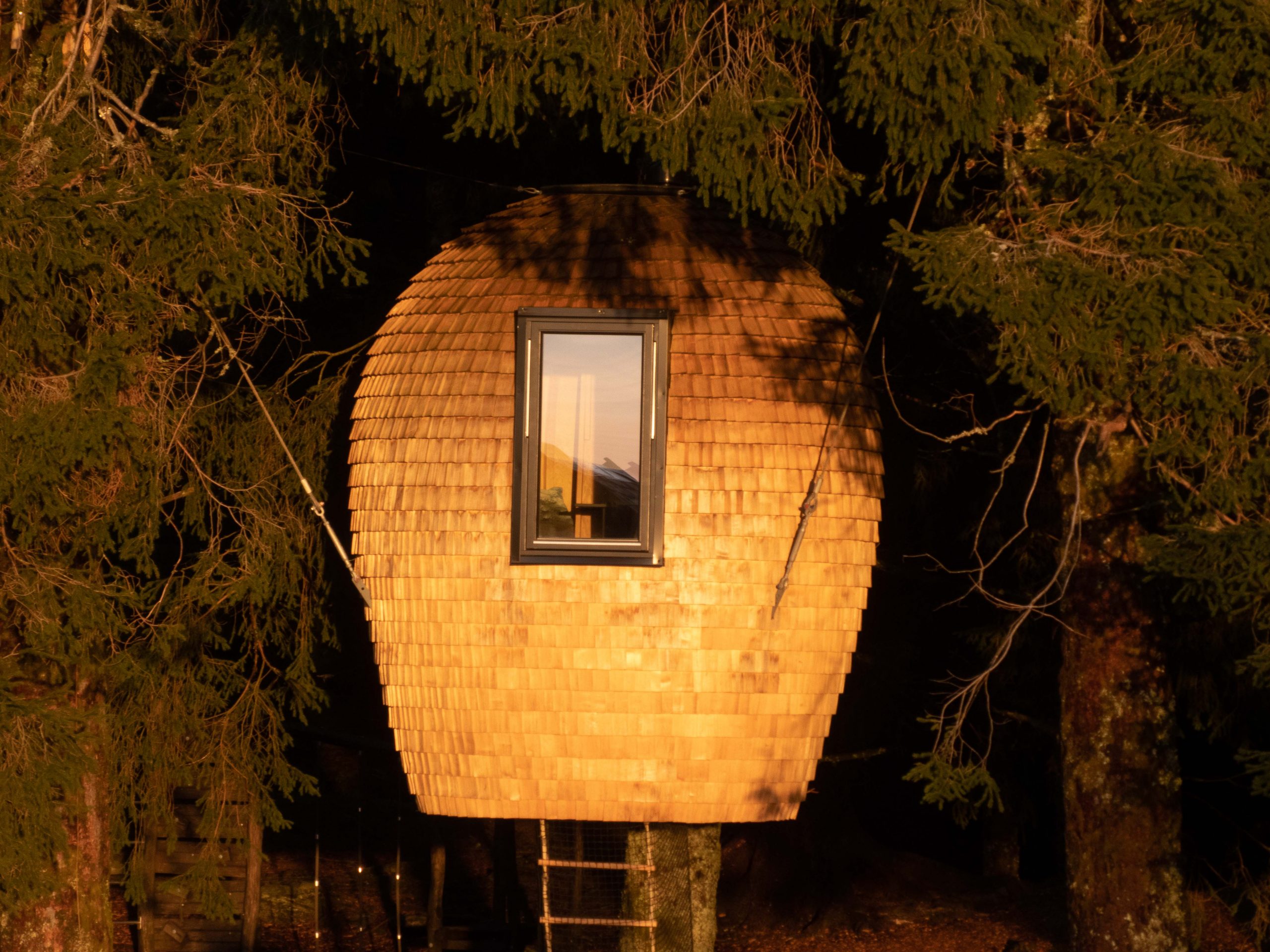
On the way back to the hotel I re-visit a third vintage clothing shop which was closed yesterday. There are two wool jumpers but one is too big, the other too small. I also look for runes. I try a tatoo parlour with a jewelry cabinet. No runes but a scottish tatooist who has been working here ten years directs me to a parlour specialising in Norse designs. Again no runes but I’m forwarded to a Norse silversmith. It is closed. I go back to the hotel. I have a very helpful Signal chat with Sue. Today I decided to give up re-reading The Eye of the Storm by Patrick White and am going to start The Hobbit. It is full of runes and pure escapism – just what I need.
Friday 27th January: Bergen rune quest
I go to the gym. I continue my rune quest. I find the rune museum (actually the Bryggen museum). A young man fills me in on Norwegian history from the Viking period, correcting lots of my misconceptions and misunderstandings, and providing me with many more things to get wrong in the re-telling. I buy a rune pendant for Bill. I go to the Fort and the resistance museum. I talk with the man who seems to run it, and learn more about the events leading up to the German invasion of Norway. Apparently there is to be a Bergen-Shetland event in the summer celebrating the little boat fleet that supported the resistance during WW2. I eat pizza and drink a beer. I return to the hotel. The hotel had a function today and not all the puddings were eaten. I check it is now open season on the puddings. It is. They are unexpectedly good. I eat lots. I go to bed.
And here are some photos from today …


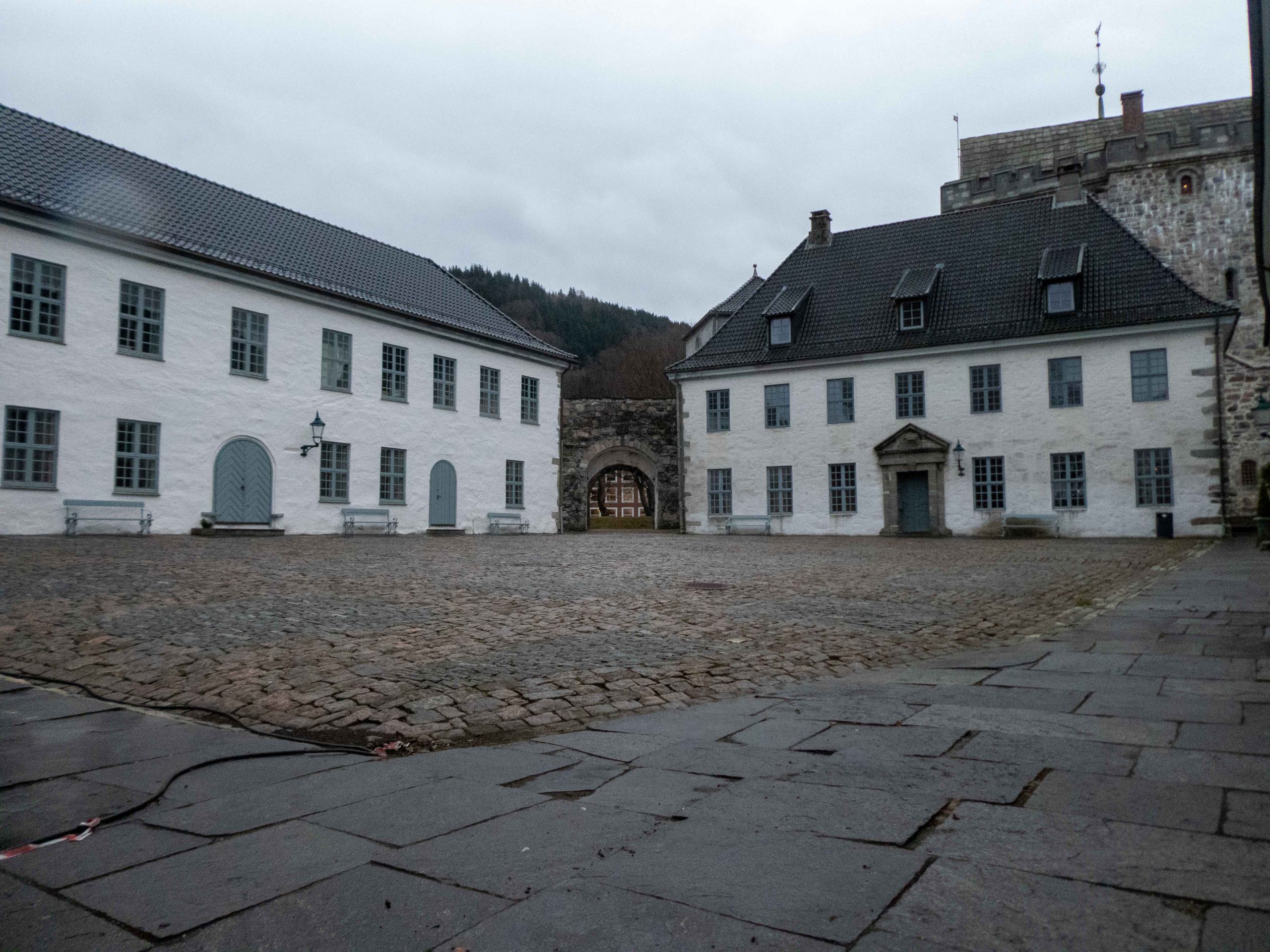
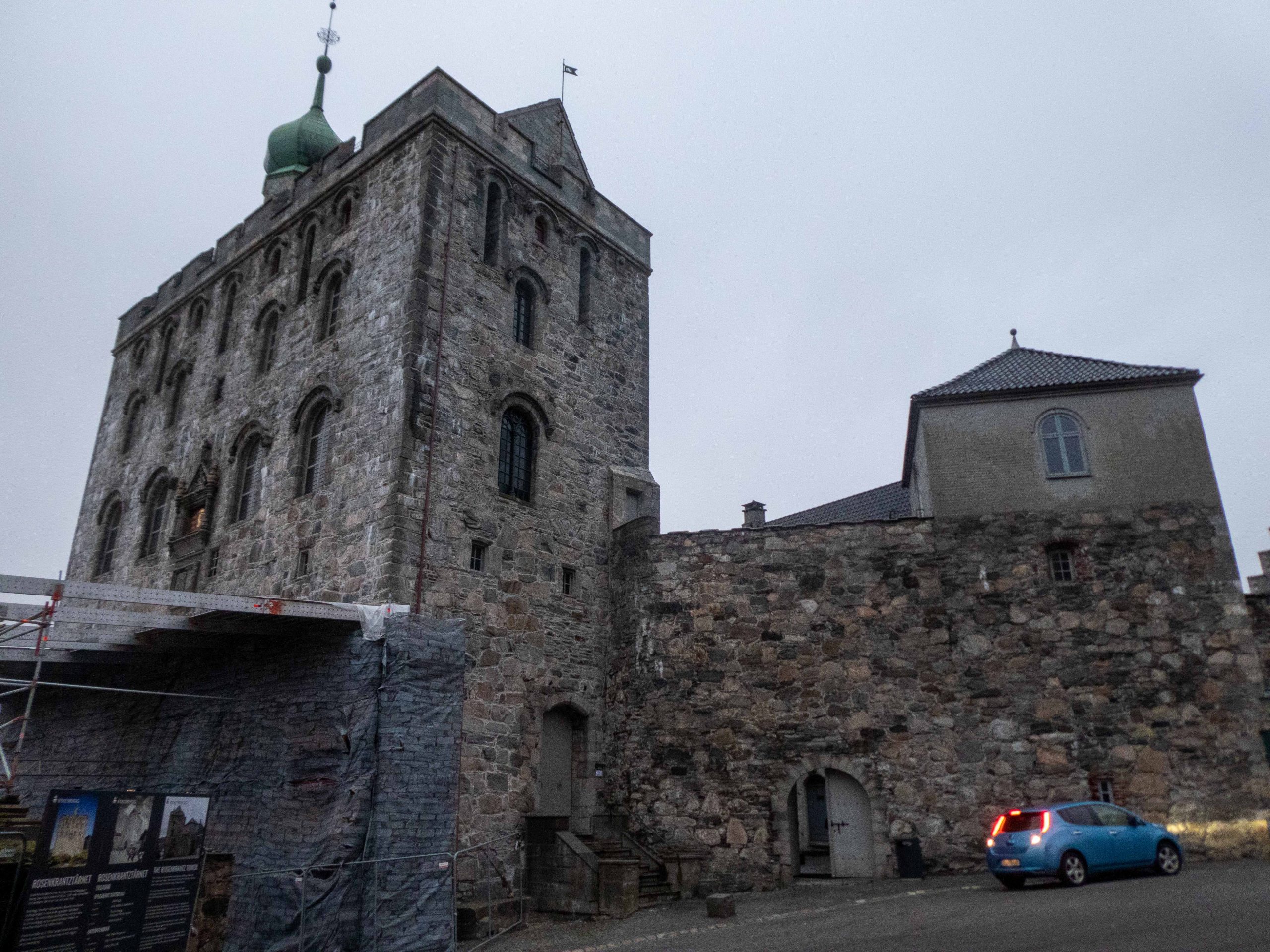


Saturday 28th January: Bergen
A day of uncertainty about what to do next. I walk to the station and manage to get an excellent Interrail map of Europe which will help me to plan. So many possibilities. I book another night at this hotel in Bergen. That gives me till Monday morning. There are no photos from today.
Sunday 29th January: Bergen
Another rest day. I realise a long loop up through Trondheim and into Sweden would be just a lot of train travel without the time or energy to do much exploring. Better to break the journey into shorter legs but keep moving south. So I book tomorrow night at the hotel in Finse, a tiny place, the highest point on the Bergen-Oslo train line. I’d thought on the way across it would be great to stop off there.
So, I have a leisurely breakfast, catch up with my diary, go to the gym, have pizza and a beer, and read.
Monday 30th January: Bergen to Flam to Finse
My time in Bergen has done me good. I am caught up on diary-writing, have sorted my thoughts, and adjusted to the re-awakenings and emotional upheavals of the trip so far. I pack and walk up to Bergen rail station in good time for the Finse train.
A train with Myrdal on its front sits next to the office where I have to book a seat, and is leaving in seven minutes. I ask the calm modern Viking serving me if it would be possible to take this Myrdal train, take the famous Flamsbana from Myrdal to Flam and back, and be in time for the last train from Myrdal to Finse. It is, and he sorts it all for me. Before I dash for the train, I tell him how much I like the many rings that adorn his fingers. Modern Vikings seem fine men with a fine look, jedi. It is unfortunate that others gone to the dark side have mis-appropriated and sullied the look.
It feels good to be moving again particularly among this endlessly stunning fjordlland scenery. Norwegians seem to have pushed train lines and tunnels through extraordinary terrain. I glimpse old footpaths hugging cliffs and realise what life would have been like back then. No wonder the Vikings did boats and boating so well. I am struck by the contrast in infrastructure between Japan when I travelled up the tsunami coast and here. There, I was also impressed by the audacity of their engineering but was saddenend by the enormous volumes of concrete being laid down. Here there seems to be far more harmony with the environment, far less concrete.


We arrive into Myrdal and transfer to the Flambana. Myrdal is nearly 900m above sea level while Flam sits on the shore of a deep branch of Sognefjord, the largest and deepest fjord system in Norway. In contrast to the rounded glacier worn shapes of the fjords, much of Flam gorge seems ripped recenty into being, vast chunks of overhanging rock seemingly just waiting to fall. And the rail track, much of it tunnelled, was done by hand. The train journey is about 45 minutes.

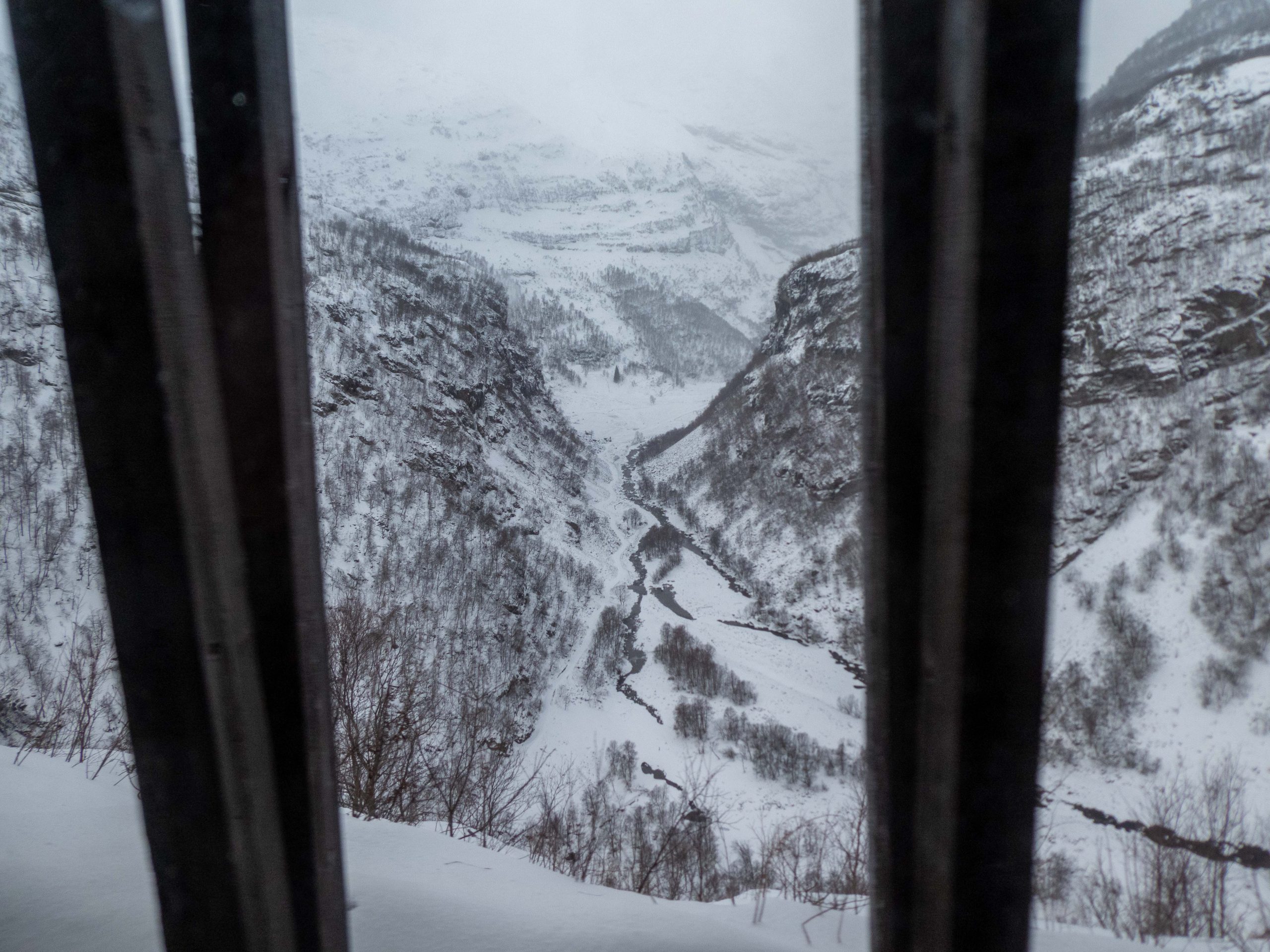


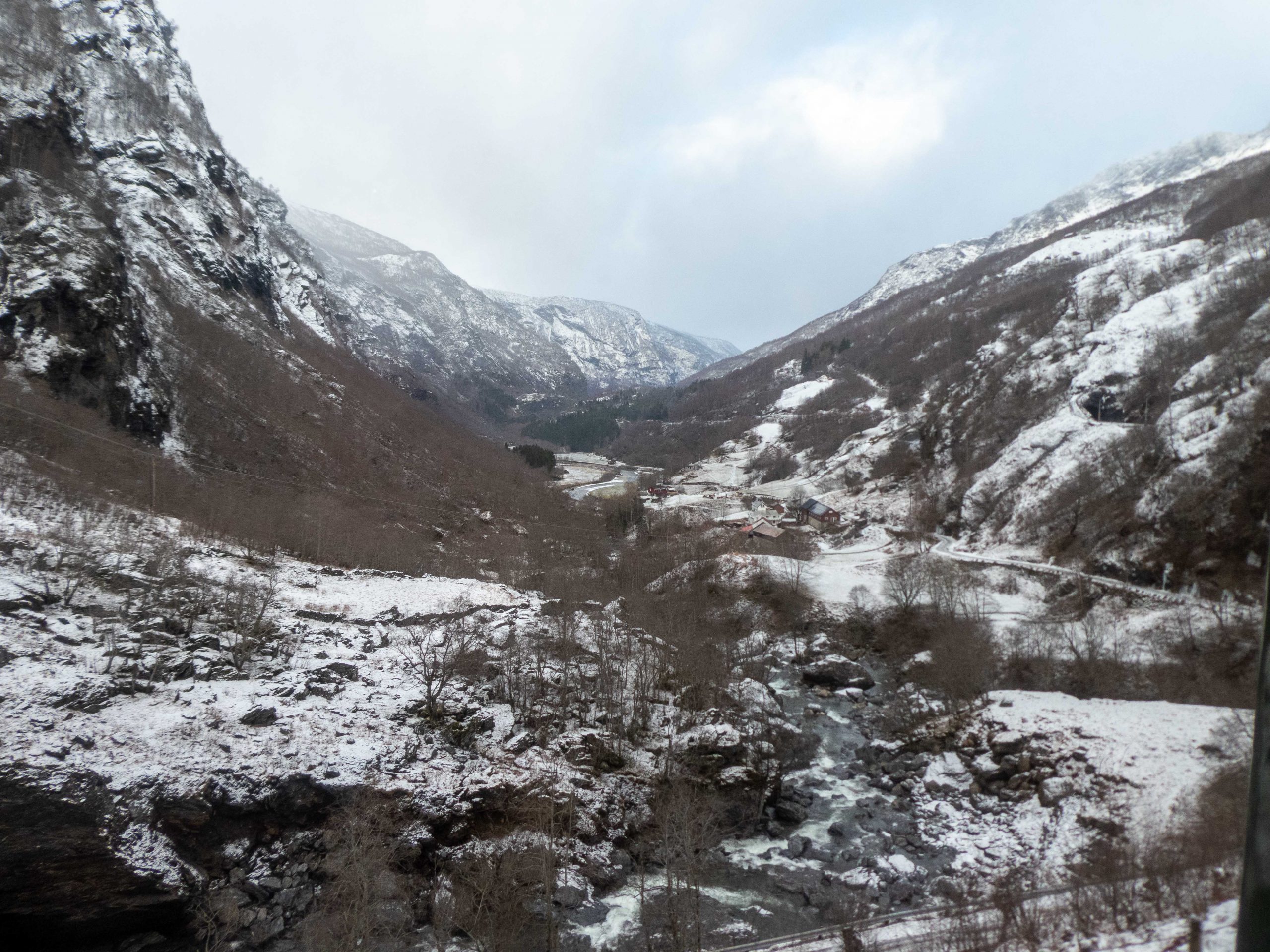
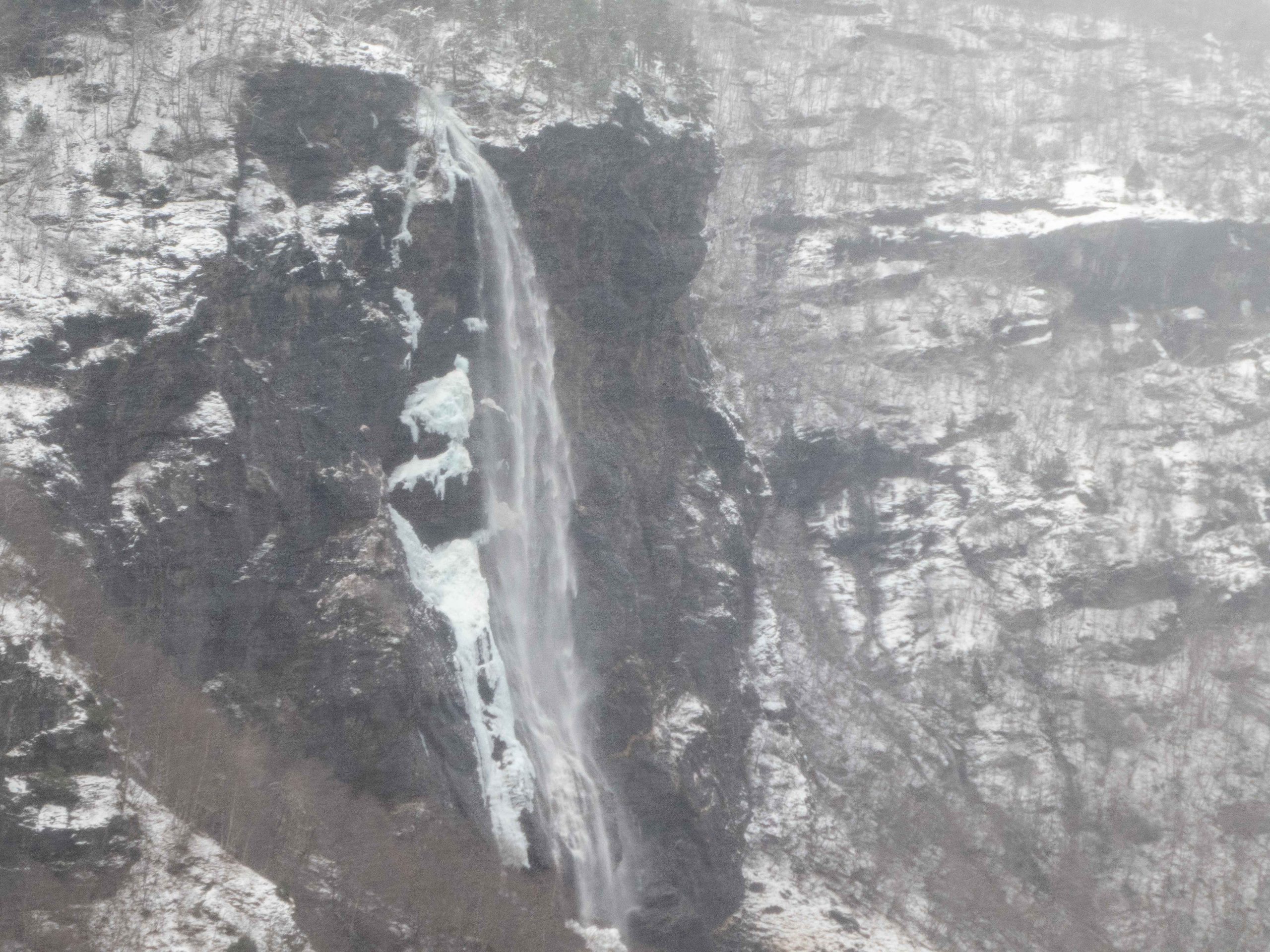

I plan to return immediately but the conductor tells me I can stay in Flam through another Flambana cycle as the Bergen Oslo train I’ll be taking to Finse waits for the last Flam train. I ask the woman at the information desk what to do and she kindly marks four cafes on a map showing some local walks. I check out the bakery for after my walk, interacting briefly with a hippyish young woman seemingly barely out of her teens in a bright rainbow beanie. I set off for the shortest walk. The girl in the rainbow beanie is walking in the same direction and we are soon chatting. It turns out she is Czech and works here as a mountain guide. She poo-poos the walk I’ve chosen and tells me to do the third walk. I point out it says 1.5-2.5 hours and she tells me 2.5hrs is for people in high-heals. So I do as I am told. It’s a good walk up to a viewpoint for the Brekkefossen waterfall …


… off a traditional path used by past milkmaids climbing to summer pastures. The bit up to the waterfall includes 571 steps made, strangely, by sherpas from Nepal. The sherpas didn’t stop at the waterfall cutting hundreds more that I don’t get to count.
One of the nicest things about Flam is the bird song. In town there are lots of sparrows, and tits; on the walk, going through silver birch woodland is a huge flock of green-streaked finches(?), some birds behaving like tree-creepers but with browner backs and whiter fronts (oh for that bird book), and possibly a goldcrest. It’s a good walk, good exercise, and ends by the fjord where I see three goldeneye and a red-breasted merganser (thank you Merlin). However the bakery has long closed.


Finse, when I arrive, is delightfully snowy, windy and cold.


The staff are friendly and chatty. The Finse Jazz Festival ended yesterday. It sounds like it was a great weekend. They were full, now they’re empty, but waiting for a large group of train coordinators from across Scandinavia to arrive later this evening from Oslo for a coordination meeting. The receptionist entices me into trying a three-dimensional puzzle game they have recently unearthed.

I opt out of dinner (massively expensive) instead having a beer and a slice of cake (also massively expensive).


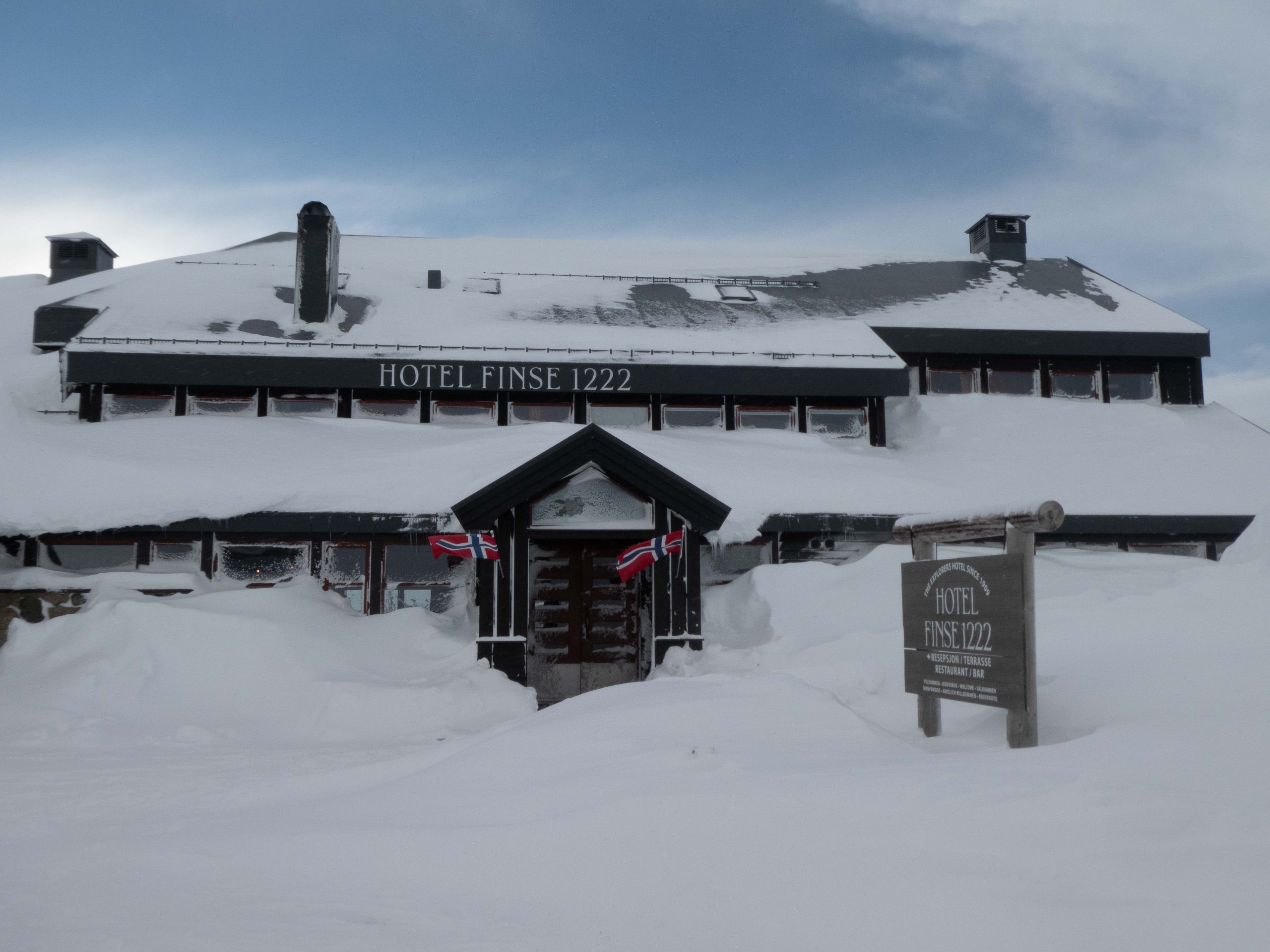
Tuesday 31th January: Finse … and to Oslo
Wake to a complex and disturbing dream. A plump milky blue worm is lying within a banana I have opened (I am shocked). It slithers out and down what looks like a drain (I am optimistic for it). But it is a sluice of boiling water (I am upset). From fragile security into a horrible meaningless death. There was more to the dream but that’s the bit that I remember now I’m awake.
This hotel makes strange noises at night. Outside the well-sealed window, the silent wind is blowing snow.

I get up and go for a cup of tea in the large communal spread of rooms. Everything seems deserted yet from the depths of the kitchen comes a song that seems to fit the mood of the place (I’m thinking it might be Bon Hiver) so I seek out the human responsible and the music is Heartbeat by Claptone. I’ve never heard of it/them and it will probably sound different away from here. (Tip: don’t use YouTube on your phone to check out the name of a song while you are in a silent Norwegian railway carriage).
Slowly staff appear, doing breakfasts, getting breakfasts, doing front desk stuff, generally getting ready for their days. Different staff seem to work different shift patterns. I am struck by how caring and kind they seem with each other, listening, sharing news and plans. I see the expression ‘takk for sist’ Egbert taught us coming to life. It means ‘thank you for the last time’, and Norwegians, who have traditionally lived geographically remote lives, say it to close friends and family when they meet again.
A sad topic of conversation is about a three-year old Alaskan Malamute, who belonged to a hotel worker, lived outside, was known for slipping his leash at night, and was hit by a train over the weekend. The details were not good, a veterinary problem. In the past he would have been shot on the spot and that would have been better for him. The trains come in very fast – and there’s nothing much else that moves fast in Finse.


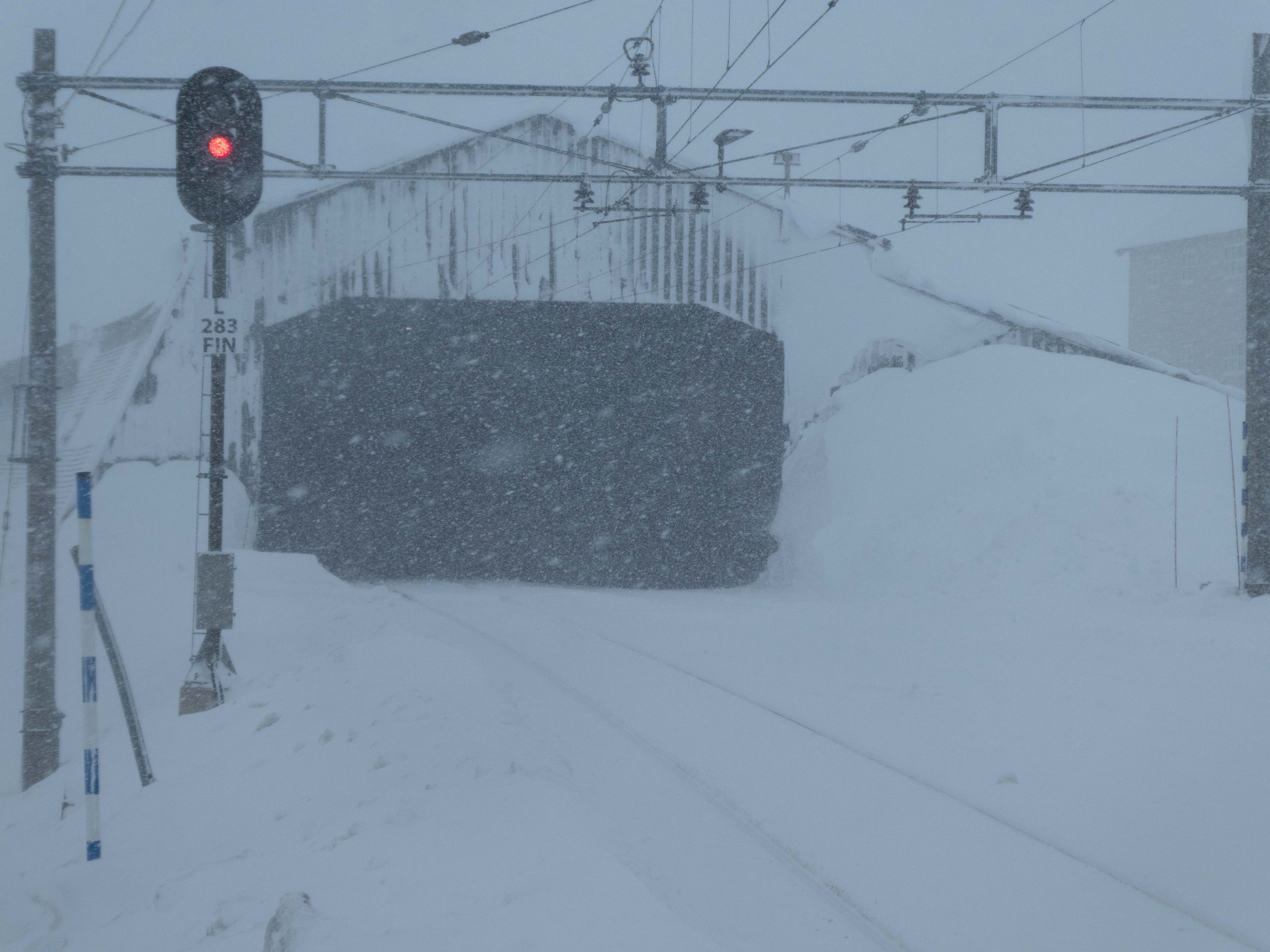


I go outside. It is snowing but the wind has died down. A train has recently passed and there is a man standing down the platform (there isn’t really a platform, just the stretch the train stops by) all dressed up with a snow sledge nearby. It turns out he is Michael, he is French, and he is about to spend 12 days crossing 100 miles of snowy, icey plateau by himself. This is where Amundsen trained for the Arctic and Antarctic. I wait to see him off as he works out how to put on his sledge harness and skis. I get his web address so I can check he has made it safe. Bon voyage, Michael! And thank you for providing another connection in my vicarious experience of polar exploration.


I lunch on bread and curried vegetable and coconut soup the kind Swedish chef allows me, and I go outside a couple more times as the weather changes between thick snow and sunshine. Small groups on skis appear around the Finse landscape. This is indeed a dreamy place.


Then I’m retracing the journey down to Oslo. I check into CityBox, a robot hotel, play Heartbeat by Claptone and dance around my little room.
Wednesday 1st February: Oslo
Plan for today: Fram museum and Vigeland Park, and sort out the next leg of my journey home.
After posting my Flam and Finse blog updates I set off for the Fram Polar Exploration Museum on the Bygdoy peninsula.

The Fram museum consists of two buildings, each a long triangle, joined by an underground cross-passage. One of the buildings houses Fram, the other Gjoa, two ships used for polar exploration. A third similar adjacent building is the Maritime Museum, which I don’t visit.

The best place to start in the mueum is the underground cross-passage. Laid out along the walls are all the major arctic polar expeditions in chronological order. Each has a map of the arctic, the same map of the arctic, but shows the individual path of that expedition. This way it sets out how each expedition builds on the ones that have gone before.
The building of knowledge is not limited to geography. Leaders of marine (and terrestrial) expeditions and the scientists of the day, helped build knowledge of the earth’s magnetic field and the realisation that the geographical and magnetic poles are not exactly aligned; of marine currents and internal streams with their various chemical compositions, salinities and oxygenation levels; of the variety of life forms, including algae, plants, animals, that live in our lakes, seas and oceans; of weather patterns, atmospheric pressures, clouds, climate, atmospheric chemistry; and of many other details of this amazing planet that we inhabit and are so casually despoiling.
Part of the interest in finding sea routes through the Arctic Sea is to ease transport and trade between Europe and ‘the Orient with its fabulous wealth’.
Rather wonderfully, the first expedition mentioned, in the 880s, is led by the visionary Ottar from Finnsnes, which gives me an excuse to include my last photo of him.

He sails up the west coast of Norway and round the top to modern day Kirkenes and the Russian coast. He finds people already living there, just as there are in Greenland and north America when Europeans arrive. Nevertheless, north into the Arctic Sea remains a great inhospitable unknown of ice and extreme weather, with little understanding of whether or where there is land amongst or below any of it.

After Ottar, there is a jump to around 1450 and then the European explorers all follow along until we get to Nansen, Amundsen, their expeditions, their ships, their crews and contemporaries.
So to the ships.

Fram was co-designed and commissioned by Fridtjof Nansen for his 1893-1896 expedition to the NE passage (a Eurocentric term for the stretch of Arctic Sea above Norway and Russia) to test whether arctic sea ice moves slowly east to west (ie essentially, as one might expect, lagging behind the west to east rotation of the earth beneath it). This idea emerged when remains of a ship, wrecked at the east end of the arctic sea above Siberia, were found at the west end, near Svalbard above Norway. Nansen planned to repeat the journey of the wrecked ship, though ideally further north, by sailing into the Artic Sea and getting locked into the sea ice for 1-2 years. Fram was designed to ride up the sea ice rather than be crushed by it. Nansen hoped his start point would take Fram close to, or even directly over, the north pole, and allow a small side expedition to reach the pole on foot before rejoining the ship. The winters were particularly harsh, the journey took longer than expected, and the attempt to reach the pole did not work out. However the crew did pioneering scientific work, and Fram proved herself a brilliant ship for polar exploration.

Fram was then used, from 1898 to 1902, by Otto Sverdrup (who had captained Fram while Nansen was away with Johansen unsuccessfully attempting to reach the north pole), for further and more extensive pioneering scientific work, this time around the NW passage (the stretch of Arctic Sea above north America). The NW passage is more complex that the NE passage because the top of north America is a maze of islands and channels and these all needed to be explored mapped during the short seasons when they were safe to sail and free from ice.

Gjoa is a smaller, older boat, originally built to fish for herrings, and used by Amundsen from 1903 to 1906 to make the first successful traverse of the whole NW passage. Building on the experience of others, he chose a small, tight-knit crew in a smaller ship, so they could more easily ‘live off the land’.


Fram’s final expedition seems to have been between 1910 to 1912, when Nansen permitted Amundsen to use her for his successful South Pole expedition, which was initially planned as another NE pasage trip. After that, Fram seems to have retired, possibly as a result of evolving ship and engine technology and design.
Actually setting foot on the boats, Fram in particular, and wandering around inside them, is very powerful. Fram is a lovely vessel, robust strong, quite open-plan below. It would have been interesting to compare life on board Fram with life on board the Terra Nova, the boat used for Scott’s ill-fated South Pole expedition as described in ‘Worst Journey …’. Fram seems to have have more individual cabins for senior crew and scientific officers, and two four-berth cabins, one of which ended up with five men sharing it. The interior has been mocked up to give some idea of how it would have been organised.


Going on board, I get a bit more insight into the experience of the men involved in these expeditions. And ultimately, this is a museum about men.
On the walls and in the display areas of the museum are huge numbers of photos and huge amounts of information. The curators have done well to unearth all they can about the crew members, juxtaposing diary entries from Nansen and less celebrated crew. Surprisingly, given his future public persona, Nansen was seen as autocratic and arrogant by many of his crew. And after the trip it seems there was some resentment about how wealthy and famous he became while the crew did far less well.
References to women are few. Nansen has a picture of his wife and new born child in his cabin when he set off for his years away. Another crew member is reported to have left behind his wife with seven little children.
The exception is with Inuit communities where the photos show whole commmunities with women and children, and women are there as equals with the men, inquisitive, enquiring. Nansen spent a winter in Greenland with an Inuit community after traversing Greenland on skis at the start of his polar career, developed a huge respect for how atuned they were with their environment, seeing it as a mark of an advanced, not a backward society, unlike the views of the missionaries who were already creeping in with their pernicious messaging. He learnt much that made him a successful polar operator from them. Yet he was wise enough to predict that their way of life, and much of thier traditional knowledge, was going to be destroyed by their contact with European culture.
There were also the sledge dogs, male and female, with litters of puppies born during the expedition. These ‘provided company and entertainment to the men’.

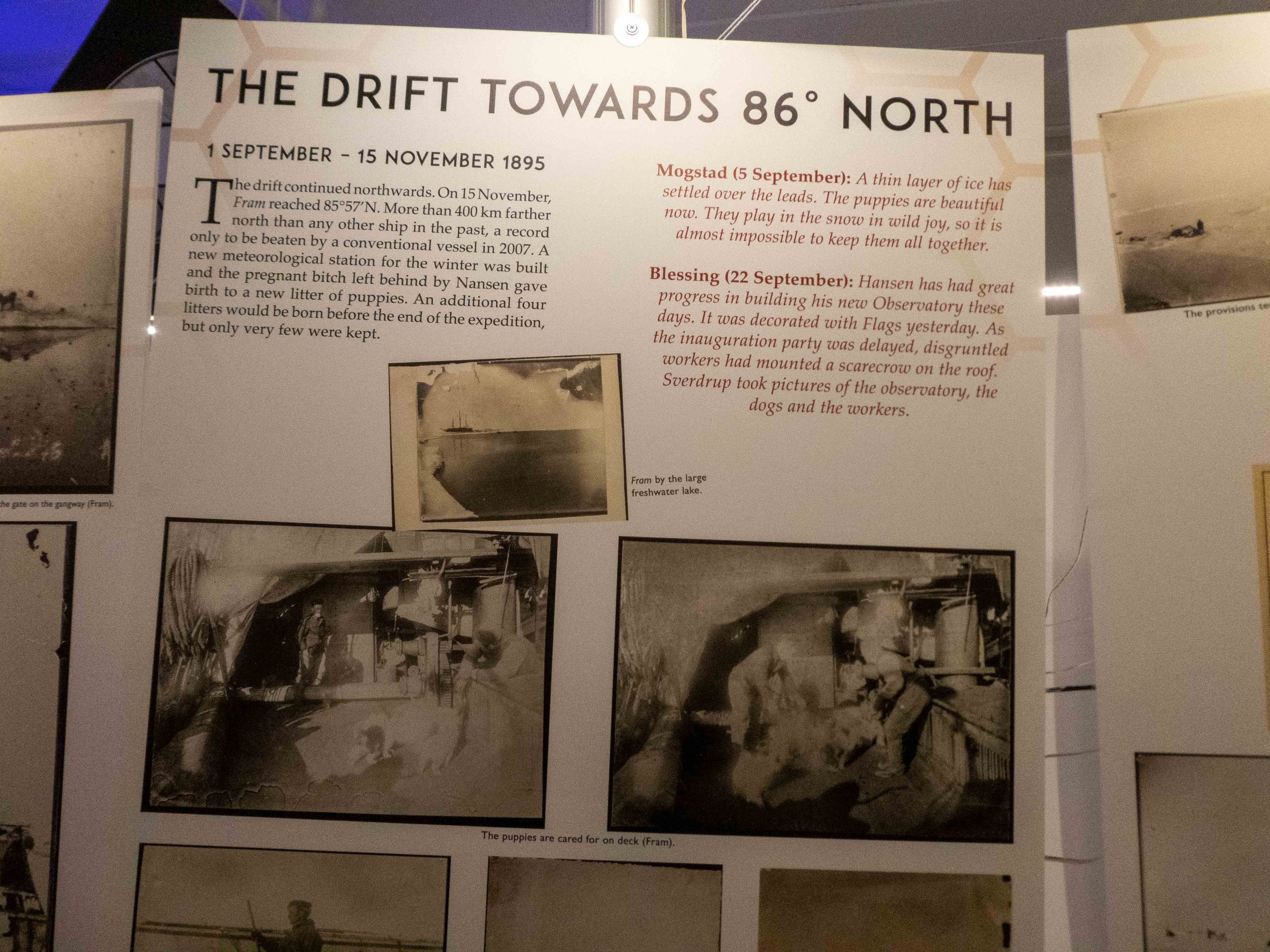
Nansen thought the dogs would be self-replicating but the harness ran between their hind legs so, in the end, they had to castrate them. One would think there were alternative harnessing systems.
Coming off the Fram at the end of my visit, I focus on a display about what happenend to the crew of the first expedition. The scientific officers seem to have had the best of it. They were responsible for detailed records throughout their time and continued their careers afterwards. Two of the boat crew continued socially isolated lives as lighthousemen. A couple seemed to die soon after leaving the boat. The most poignant and haunting is Frederik Johansen, the man chosen by Nansen to accompany him on his attempt on the North Pole, and later by Amundsen to go with him to the South Pole.


His story is described in the photo below:

After reading the above, I go back to re-read some of the correspondence with the photo collection. Below is just one fragment.
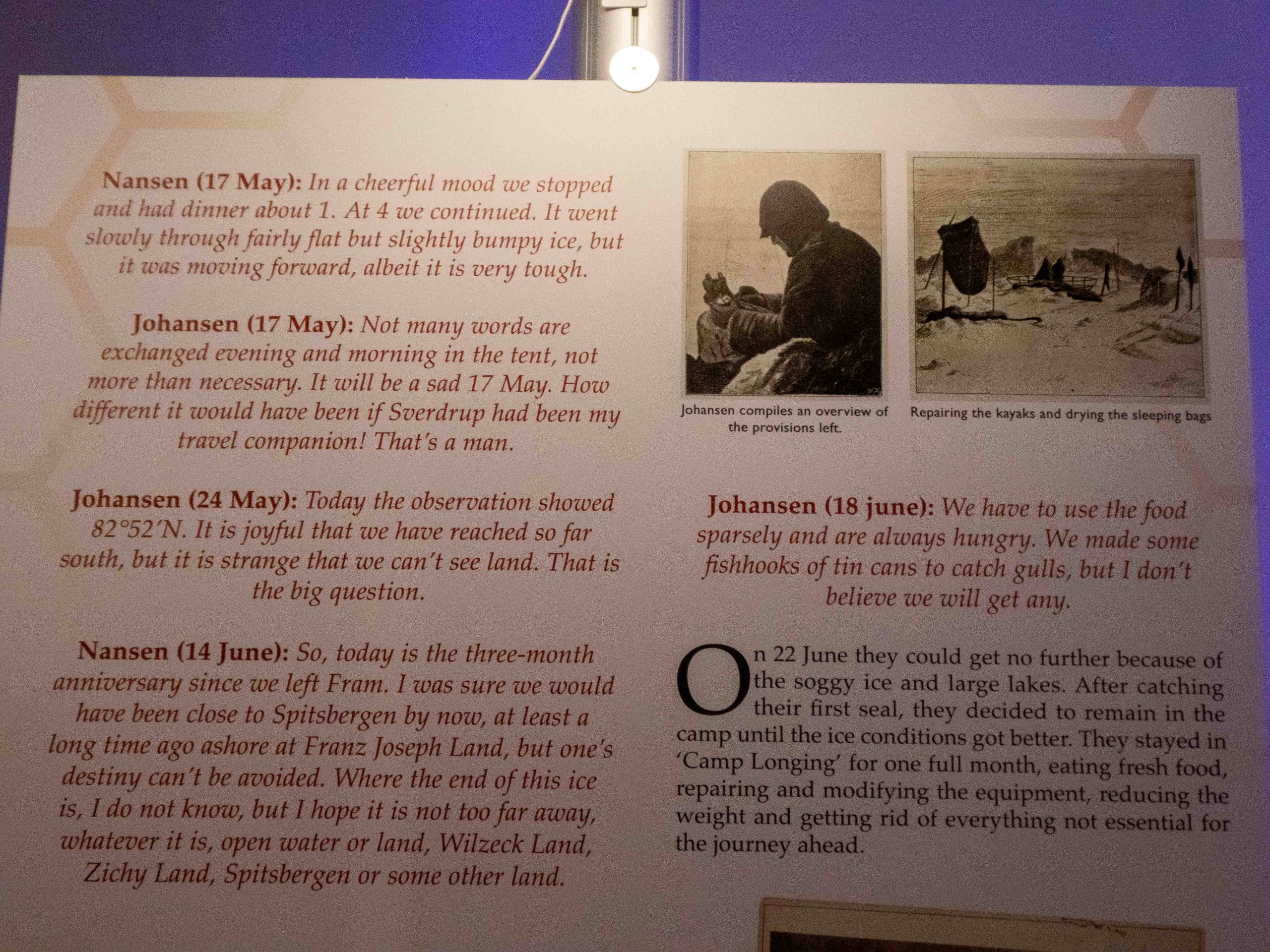
It seems Johansen was loyal and got on well with other members of the crew. His solitary end seems achingly sad. And he is not the only one.
I see the stories around Fram and Gjoa as representing all the men in all the expeditions. We know the expedition leaders but, before the days of photography, there are few pictures, and few records of all the other men, and in a few cases women (from the Tromso museum) who did so much of the work and made the expeditions possible. Who are these individuals drawn to the wild fraying edges of human community, their threads of connection fragile, easily hurt and broken?
There are few records too of the indigenous people, now mostly gone or homogenised.
And we know so many of the animals are gone or going too. The Tromso polar museum dealt with the hunting side of polar travel and exploration and provides another viewpoint. We know now that fish stocks, though managed, are declining, and with the ice melting, the exploration, this time for sea bed petrochemicals and minerals, has not stopped.

Despite all the above, there are fun activities in the museum. What weight of sledge could you pull across the ice? Could you pull the 300kg the sledges routinely weighed? Strap yourself in and have a go. (No, is the answer. I managed about 100kg before deciding I don’t need to damage my back). Go inside a replica igloo. (Helps imagine the real thing slightly better).
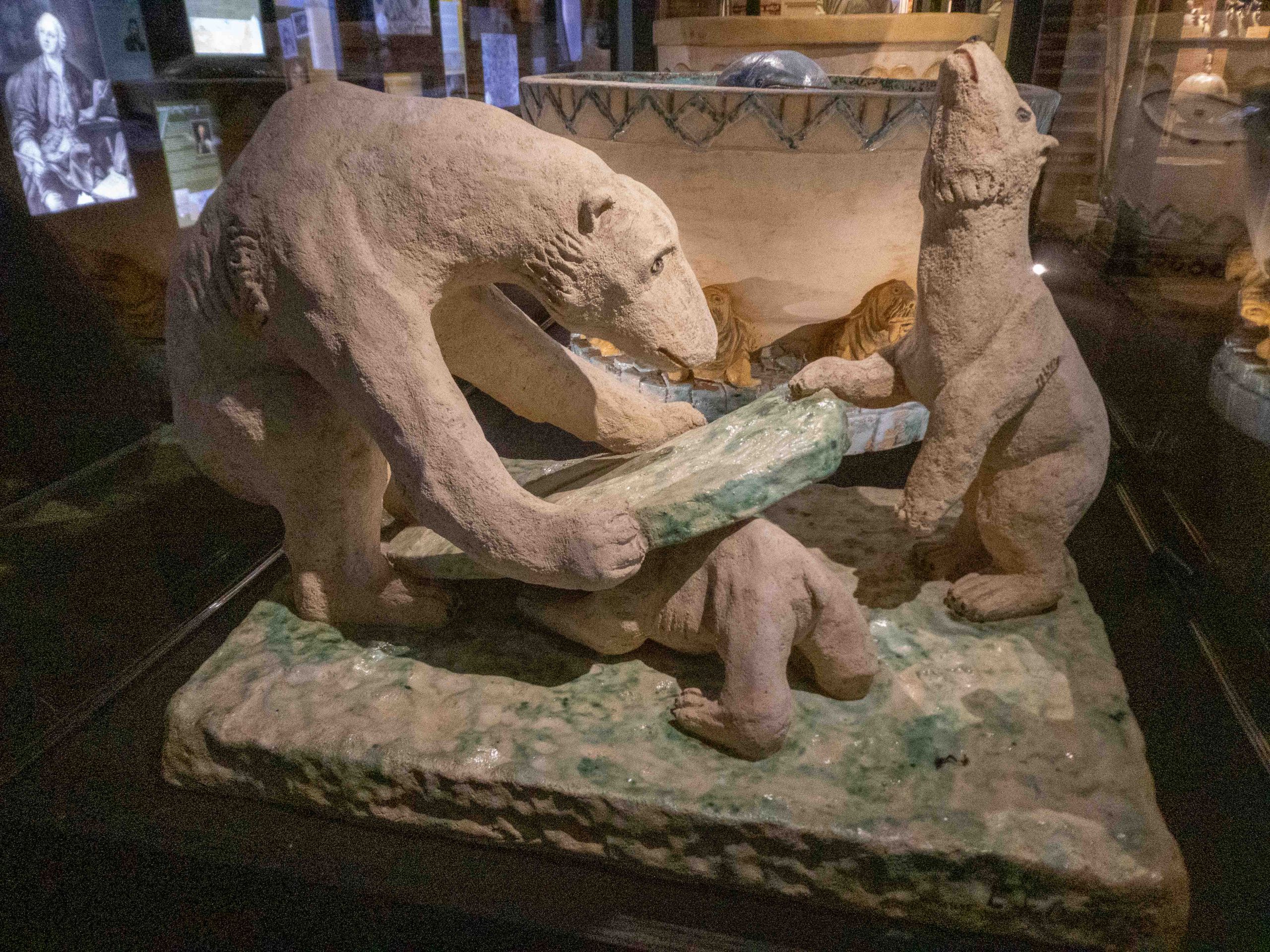
Finally, as if this museum hasn’t offered enough, there is, sharing space with the early explorers in the underground cross-passage, a display of quirky polar-inspired pottery by Theodor Friestad:




After leaving the Fram museum, I go to Vigeland Park. Fortuitously I have to change buses by this piece of graffiti which I have seen on the way down.

By the time I get to Vigeland park it is too late to see all Vigeland’s statues properly …
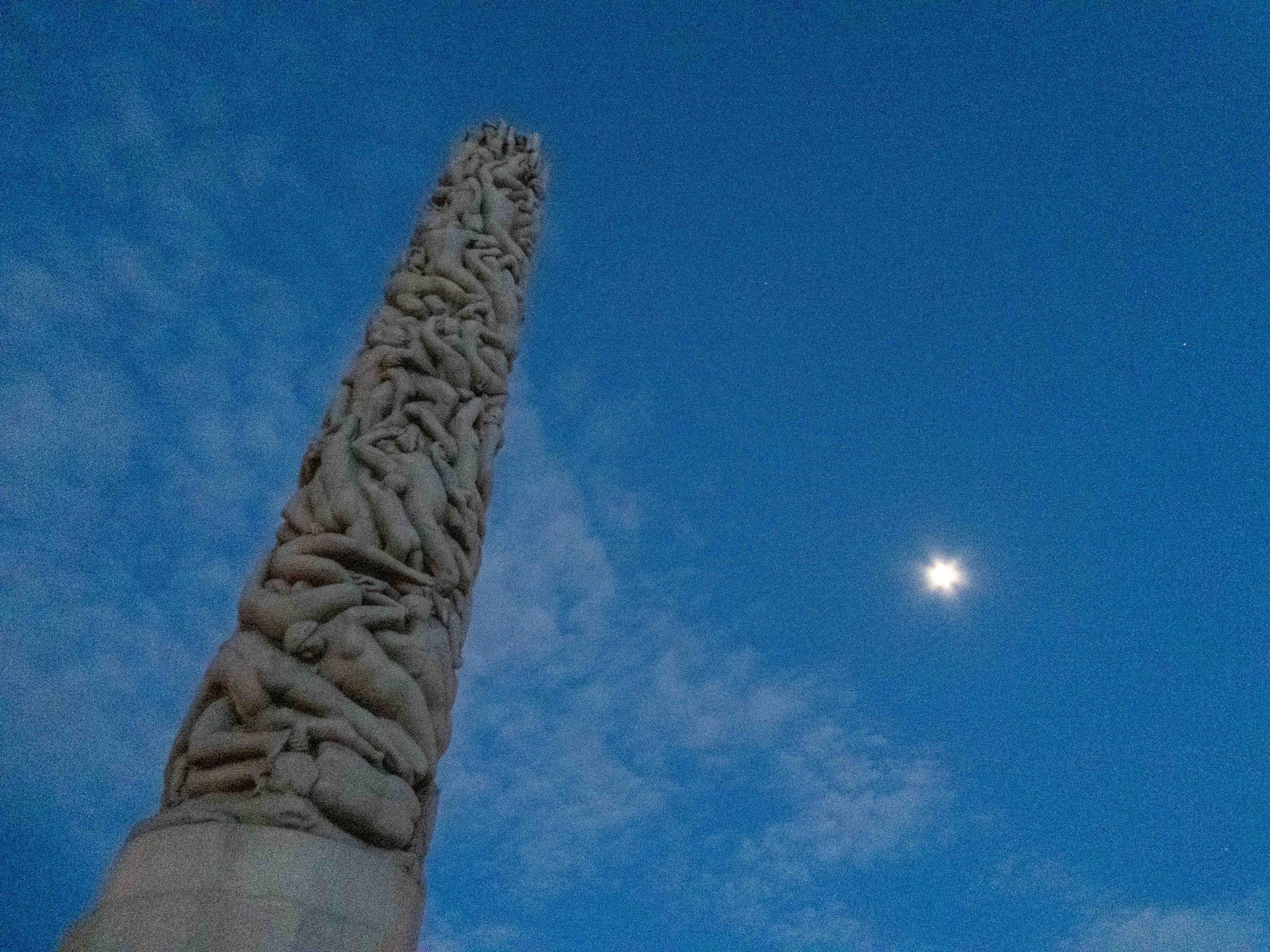
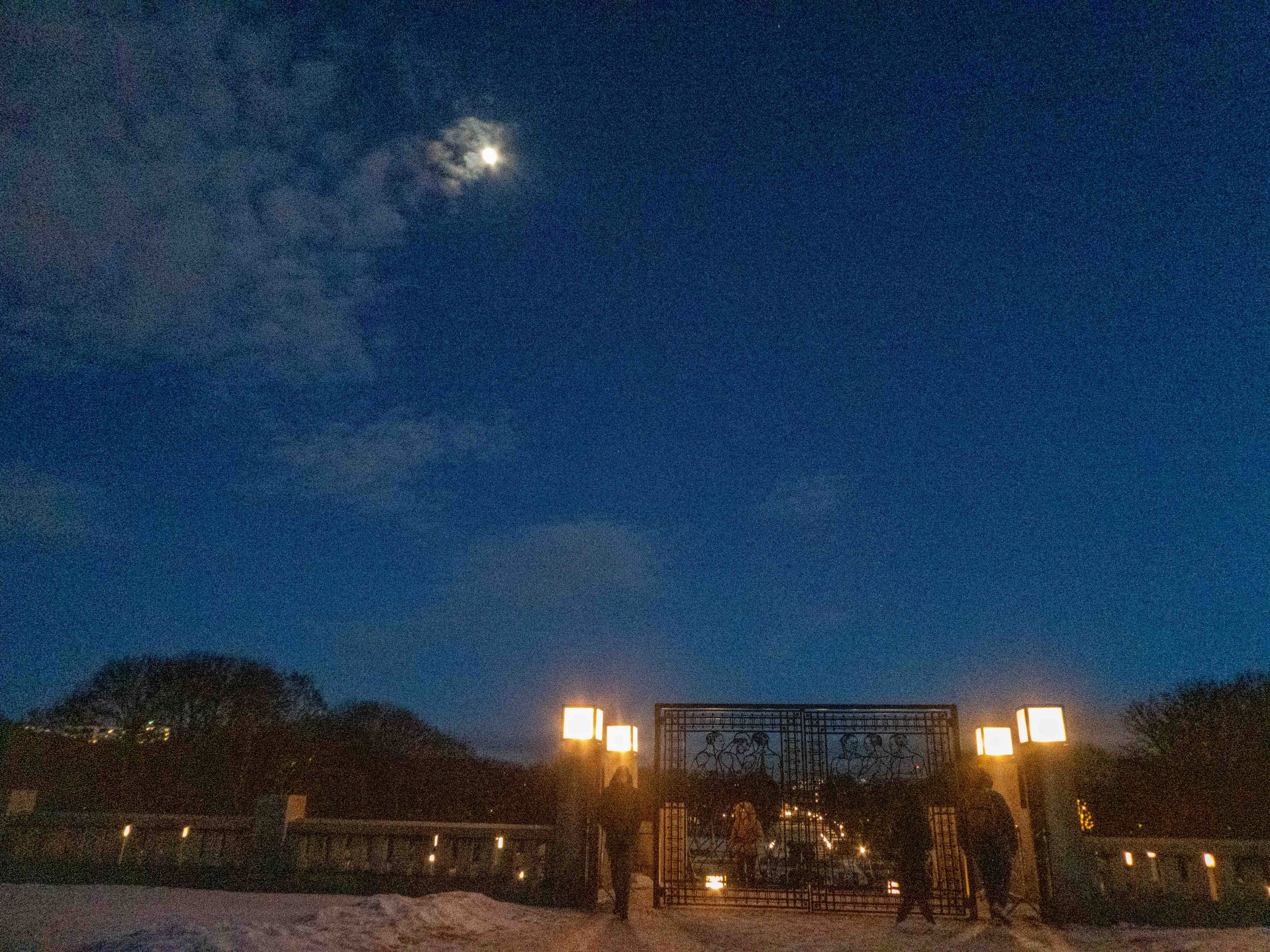
… but I see enough to want to come back another time.
Interlude: ‘Explorer’, a new short film by Andrew Pengilley.
Andrew, a film-maker friend who like many of us has been afflicted by lockdown, has just sent me the link to the first film in a ‘twelve new short films in twelve months’ challenge he has set himself to get his creative juices flowing again. His film ‘Explorer’ seems so pertinent to this point in this blog, that I am including it here. If you like it, please comment on YouTube and share it.
Thursday 2nd February: Oslo, Ice Hockey and to Goteborg, Sweden
Today I feel sad to be leaving Norway.
It is such a beautiful morning, it seems criminal to be leaving on a day like this. While I await my train to Goteborg, I wander to the Operahuset for a look around.


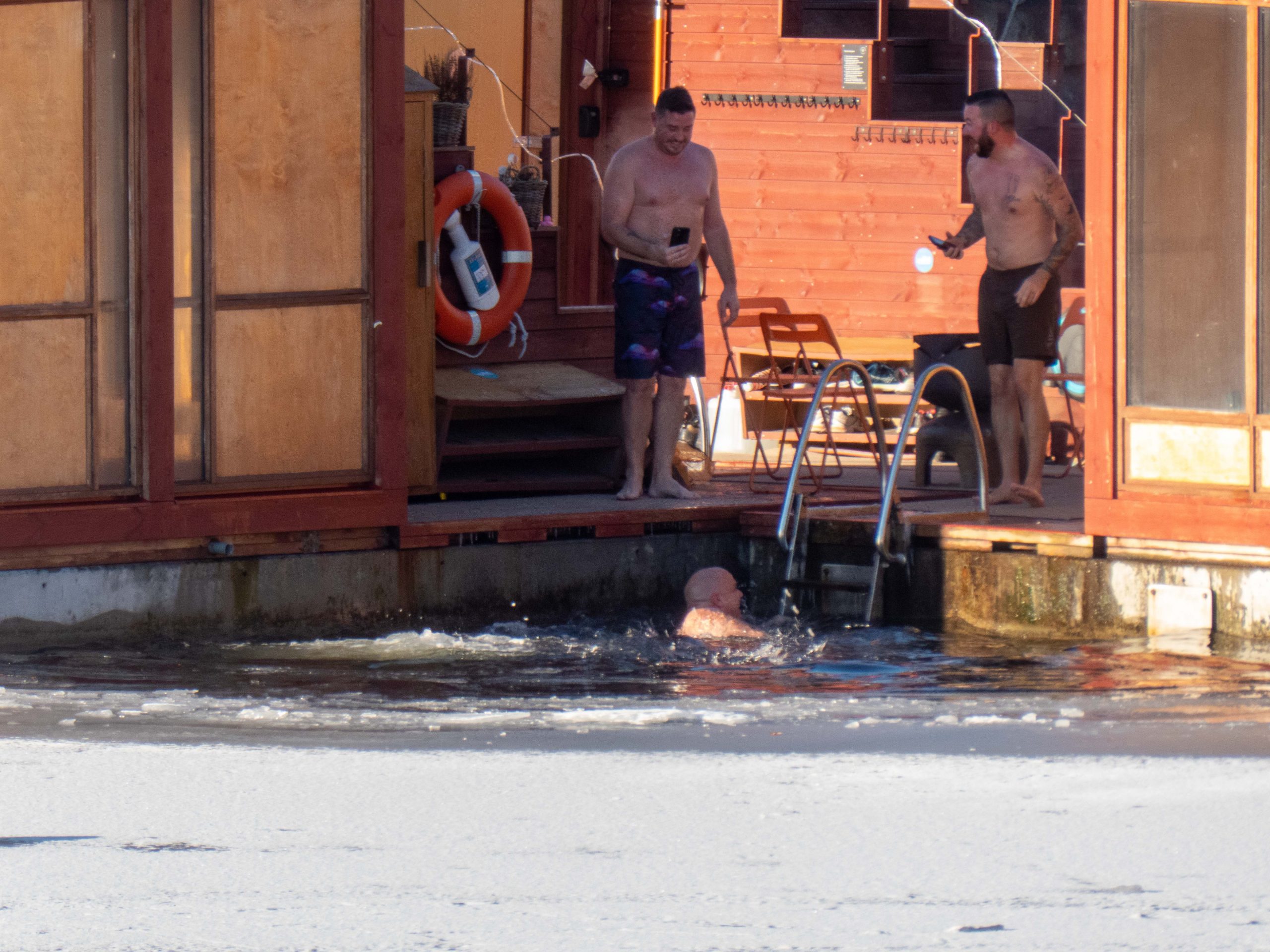

Outside the train station, a three small boys, aged two, four and five, practice ice hockey with their father. They seem extraordinarily good, many people watch.


The father is very approachable and modest about his own skills. The five year old has been on Canadian TV – my videos do not do justice to his skills. As various women watching attest, the two year old is adorably cute.
A man I chat with on the train to Goteborg mentions there is a ferry from Goteborg to Frederikshavn in north Denmark . This sounds a pleasant way down through Denmark to Germany avoiding Copenhagen.
Friday 3rd February: Goteborg, Sweden to Aalberg, Denmark
It is snowing in Gotenborg! I spend the morning walking around in it. Once I’ve sorted the ferry I take up the challenge of spending my remaining cash. Sweden is becoming a cashless society. I buy ferry food, then chance on a cash-friendly Yves Rocher shop with a sale, so I spend the rest on hand cream.
Filmed partly at Finse, Star Wars lives on in Scandanavia, with events helping modern Vikings from going to the dark side.

The ferry to Denmark starts in Gotakanal …


… and goes out through low lying islands into a deepening dusk.


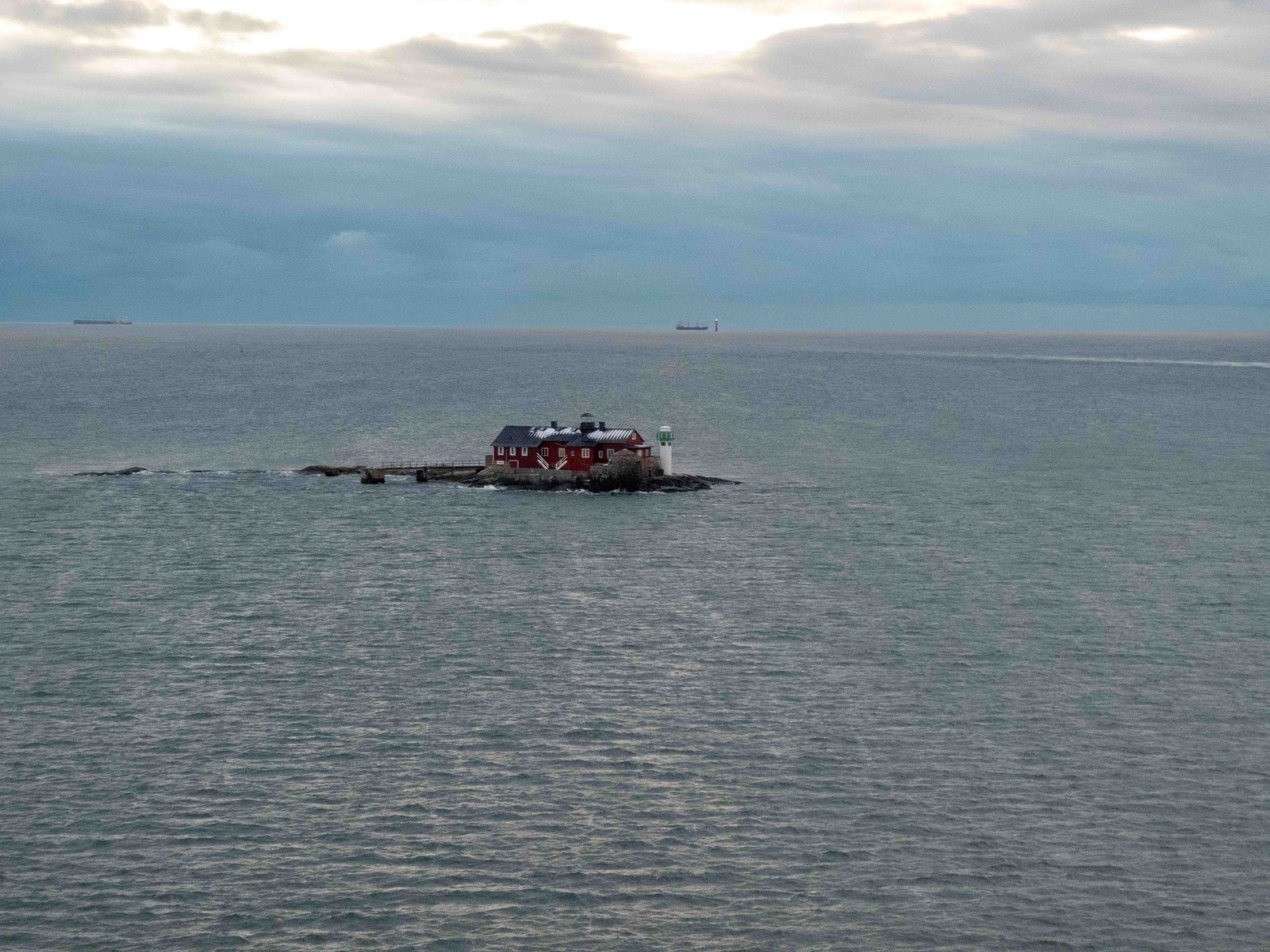


Friday night on the Frederikhavn to Aalberg train seems to be when the youngsters of north Denmark get to party, but Aalberg on a short late night walk down to the water is surprisingly quiet.
Saturday 4th February: Aalberg, north Denmark
Spend most of the day in bed. Finish The Hobbit. Chat with Sue who is watching the start of the Six Nations Rugby. Book another night. Will head south again on Monday.
Interlude: Alaska ManlyMan Lip Lube
A shout out for Alaska ManlyMan Lip Lube in its lovely little tin …

… which for a manly man such as myself, has proved just the thing to keep my lips in tip-top condition through a voyage in the Arctic winter. A big thank you to Sue and Gill for bringing some home!
Check out their website – www.denalidreams.com – for some consumerist fun!
Sunday 5th February: Aalborg, Denmark
I spend today in Aalborg, Denmark. As I’d hoped it would be when I spotted its location on the map, Aalborg turns out to be a picturesque and historically interesting little city, the northernmost city on mainland Denmark as it sits on the southern side of Limfjord, a channel that cuts across the country making everything further north an island. It used to be called the gate to Norway as it controlled the trade of goods north. In the morning I do a bit of sorting, have a good video chat with Bill from Vesteralen about meeting up again back in UK, and in the afternoon go for a walk. I apologise that I am becoming a bit unselective and indiscriminate with my photos, but this is what I saw.
Some old streets and buildings:


Two churches:


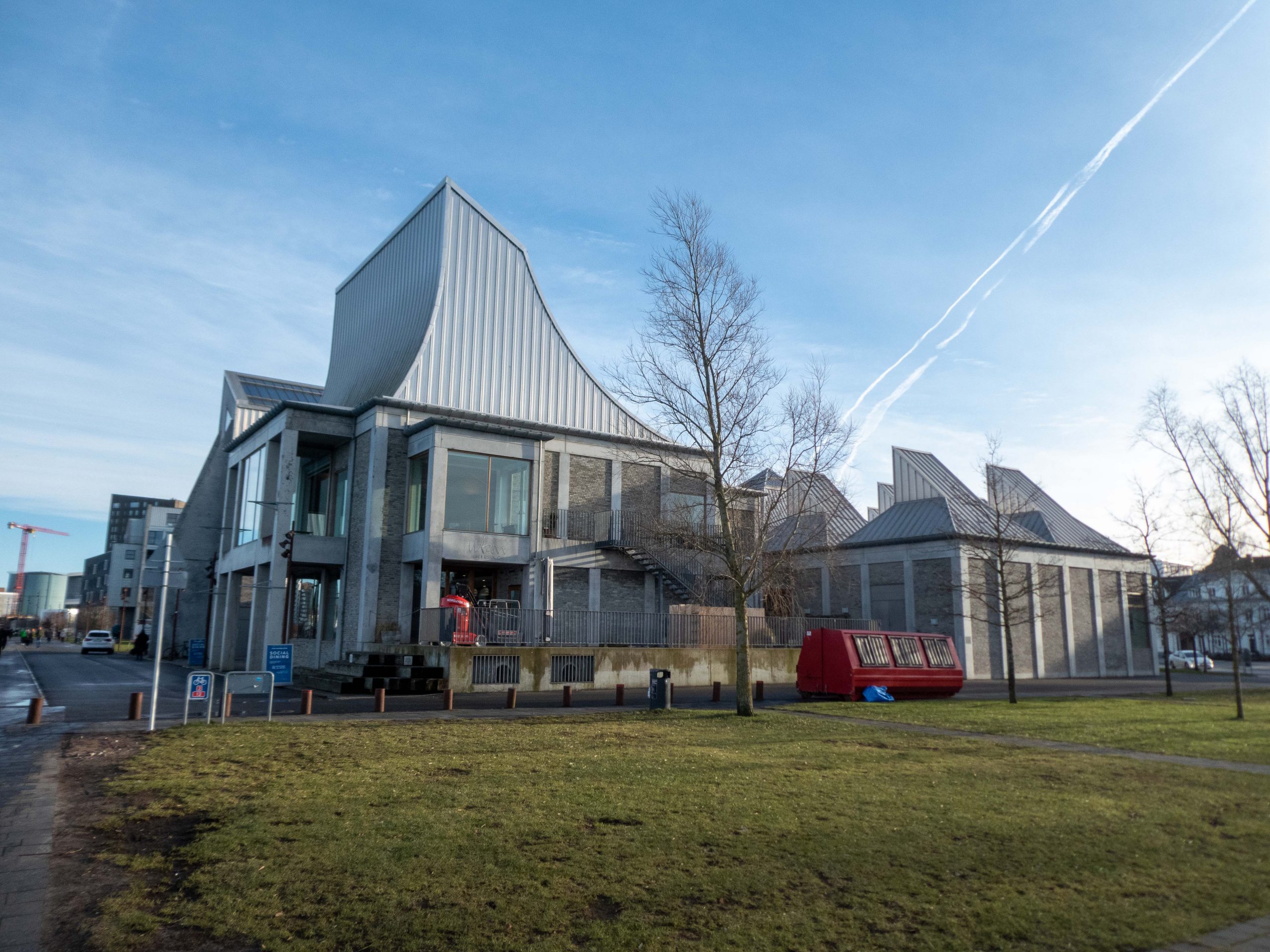
The Utzon Centre (Utzon grew up in Aalborg and designed the Sydney Opera House):



Limfjord, the water channel:


The Aalborghus Anlaeg (the Old Fort):

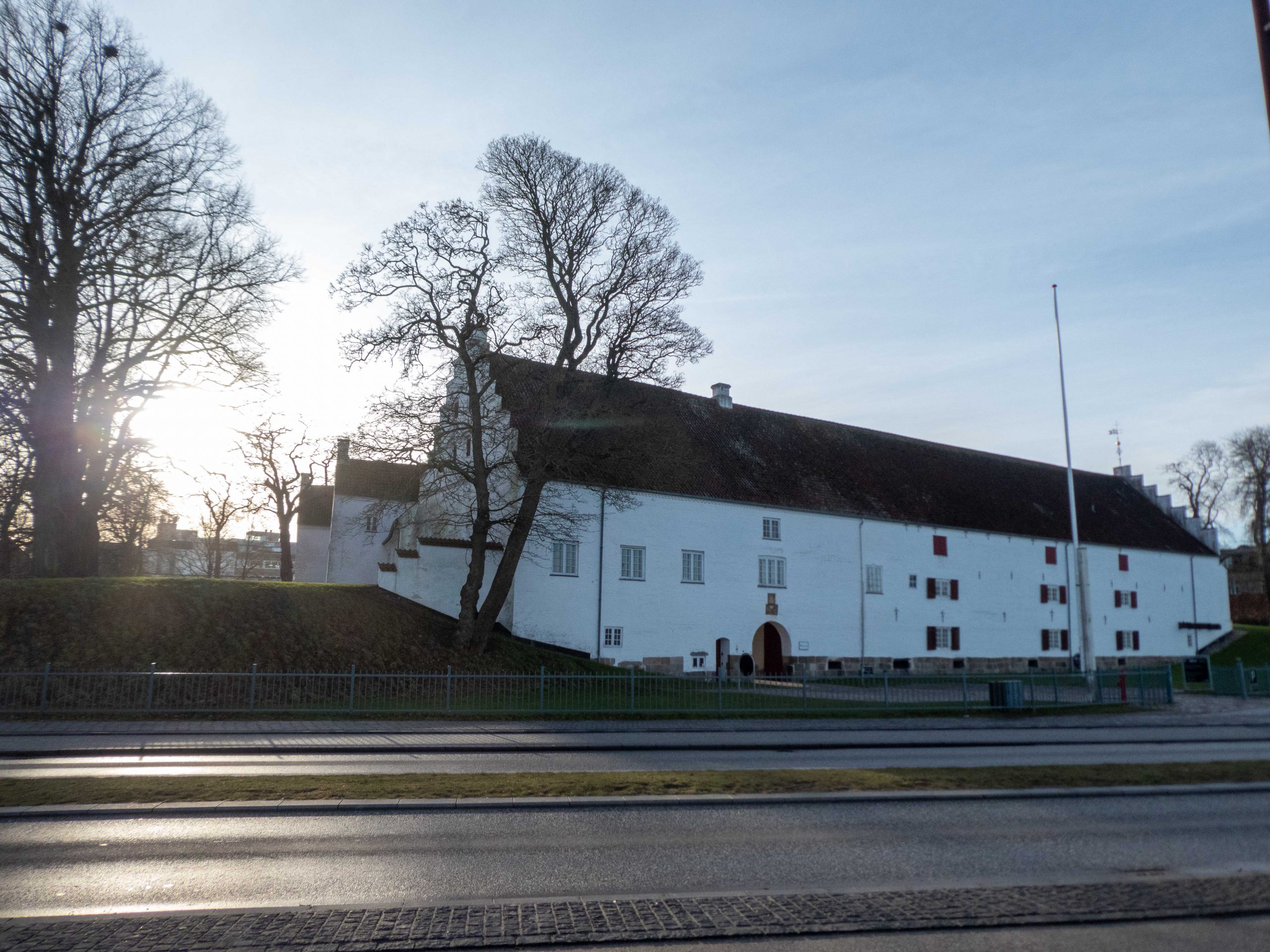


An old religious house and hospital:
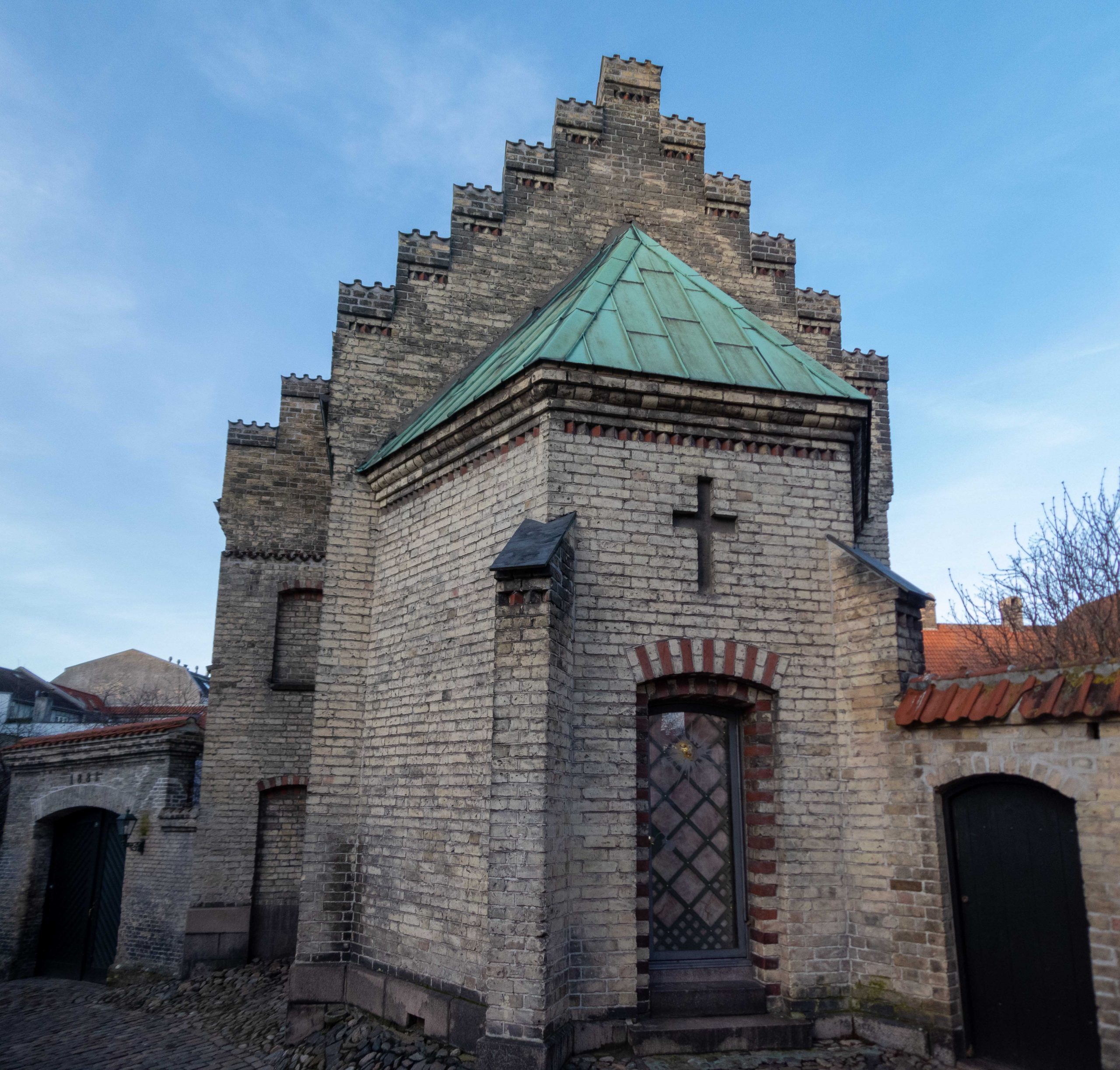


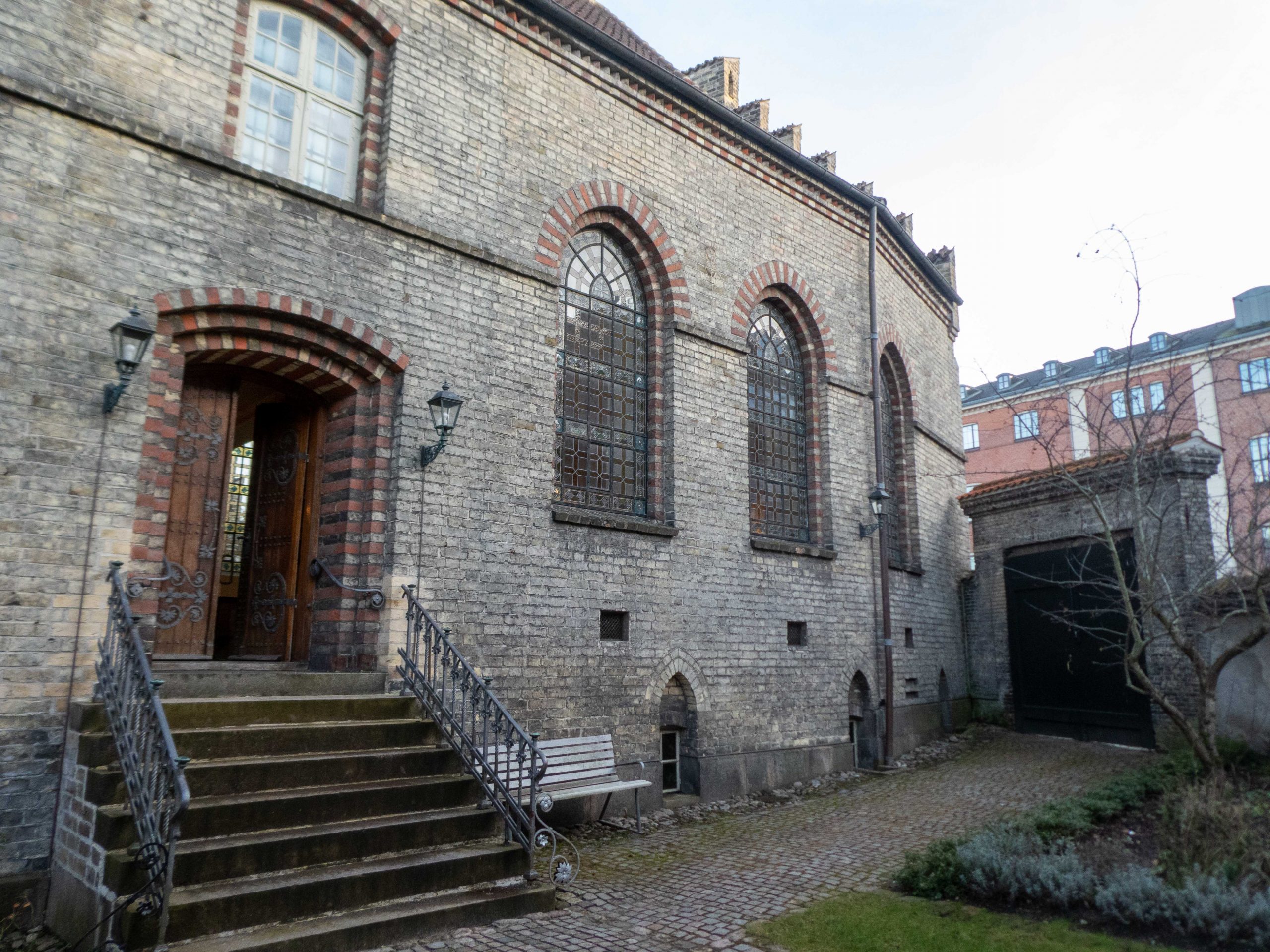


A music centre complex:

An apparently unique juke box wood. Each tree has beside it a post that plays a medley of hits from an artist who has performed in Aalborg – from Bob Dylan to Cliff Richard:

And finally this great statue of a bull (The Cimbrian Bull by Anders Bundgaard – thank you, Bill!):

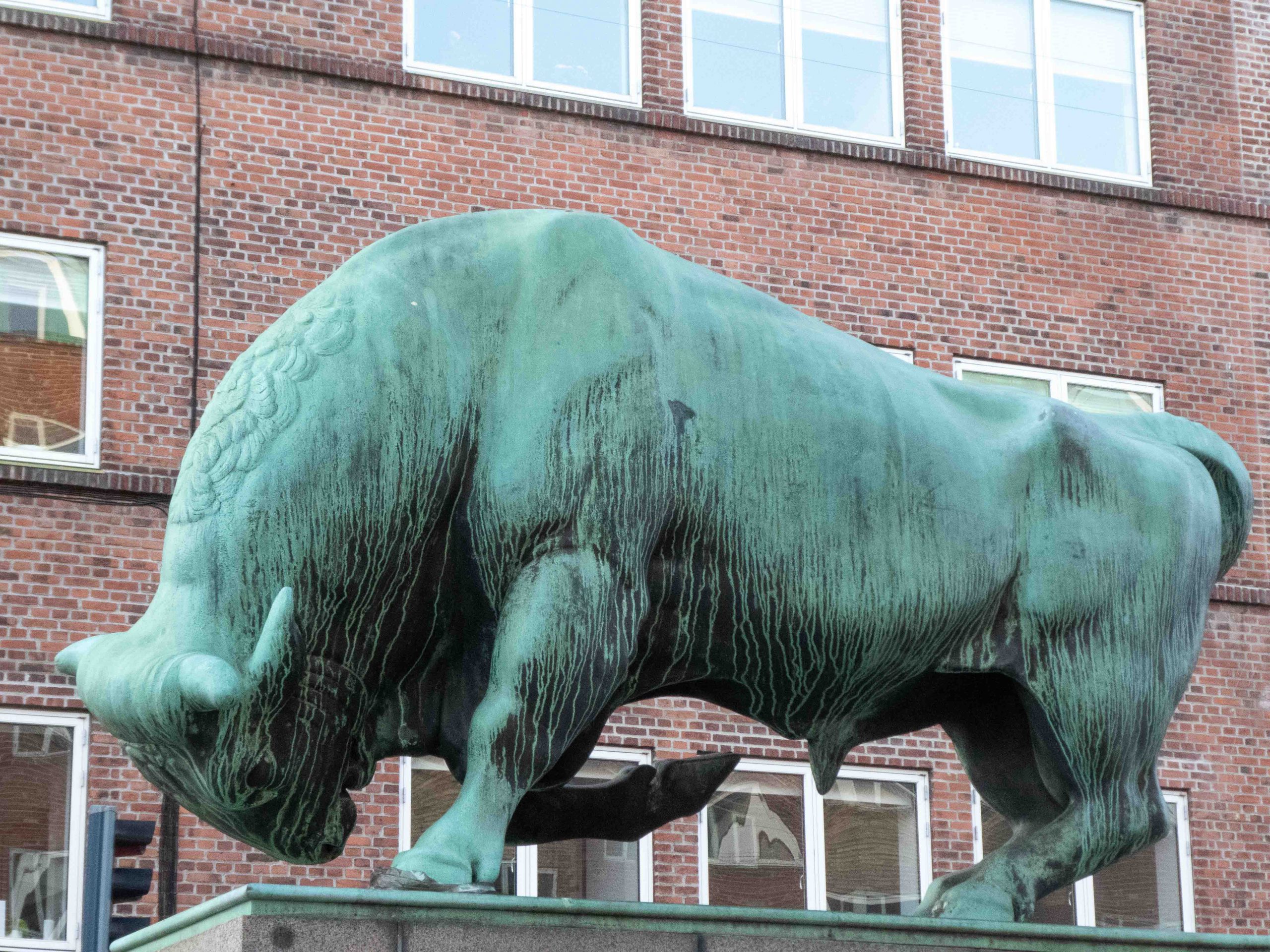
I could probably say more about all these buildings, places and things. If you would like more detail, please ask.
Monday 6th February: Aalborg, Denmark to Hamburg, Germany – and a bit about Seven-Elevens
Seven-Eleven stores pretty much run Scandanavia. I ask: where do I go to buy a bus ticket (which are not sold in buses or bus stops)? I’m told: try the Seven-Eleven store. Where do I buy stamps? Try the Seven-Eleven store. Where can I use my cash? Try the Seven-Eleven store. Affordable food and drinks, the Seven-Eleven store. And now I’m in Aalborg railway station and there is no office to check train times or platforms. There is only a Seven-Eleven, and the young woman I talk to, who confirms that they are the place to go for all rail tickets and enquiries, uses an App on her phone just like I could. I have an hour in Fredericia and the only diversion for miles around is a Seven-Eleven store where the friendly young woman is happy to discuss cookies, which are better, what is the best deal, how she can help me optimise my choices etc. Then, I’m on the Fredericia-Hamburg leg of the journey thinking about blogging this paragraph, when who should appear but this young woman …
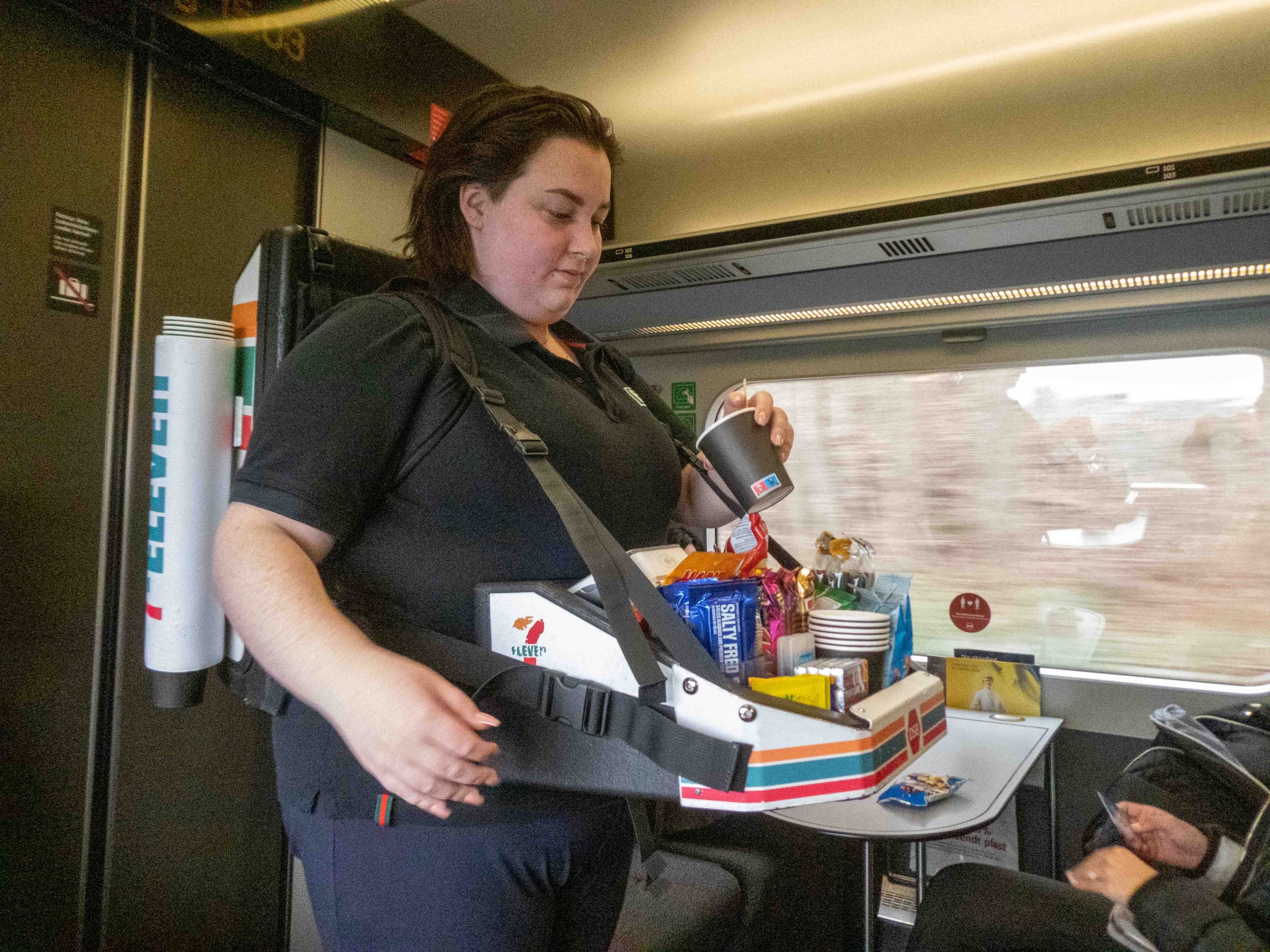
… who, when I explain why I’d like it, gamely agrees to let me take her photo. We then get into a long conversation. It turns out she is actually paid by the railway company, as are the staff at the station Seven-Eleven stores, so there seems to be a bit of symbiosis going on. And she gets some rail company perks – train passes for example, though I am not sure if this is a general pass or just from her home to her place of work – but there is a limit to how forensic I can be in my investigation. I ask about health and safety – that looks a very heavy and precarious piece of apparatus she is carrying around. She says the rest of the train crew are very supportive, warning her when there is a likelihood of sudden braking for example. She has also picked up tips, such as standing where she can lean against a seat or other available upright, and shows me how she is doing this even as we are chatting. We discuss trolleys. The issue is the flexible bit between carriages which, I have noticed myself, do not necessarily feel safe on some of the Scandanavian trains I have been on. It shocks me that I may have found something about a British train carriage than is actually better than its continental cousins. I tell her British train trolleys work fine. I will have to take a closer look when I am back in UK to check how our carriages link up that makes them feel a bit more secure. The thing that most reassures me about her well-being, is that most of her time is spent in a little booth the train company provides where she sells a slightly wider range of products than she can carry about. So her trips up and down the train are mainly for marketting purposes.
Much of the train ride from Aalborg to Hamburg is in thick fog. Glimpses from the passing countryside: paths curving round the edges of birch woodland; a winter pool in a clearing with an island of reeds; three dogs taking off after the train, one fine collie in full flight and it dawns on me that the Malamute in Finse probably attacked the unexpected monster that crashed into his space.
Tuesday 7th February: a day out in Stade, old Hansa town near Hamburg
My day in Stade starts rather strangely. I go to check platforms for my train to Stade and the man in the Hamburg railway information booth (this is a huge station, so thank goodness they have one) instead of just telling me, chooses to question why I am going to Stade at all, which he seems to disdain for some reason, and proposes lots of places that he thinks I, as a tourist, ought to go to instead. I am intrigued and amused but he won’t be drawn. Eventually he prints me out something about the wrong train. Oh for a friendly young woman in a Seven Eleven.
Anyway, I go to Stade which sits down a small tributary of the Elbe, defensible and navigable to trade boats in Hansa times. In the Rathaus (which I visit later in the day) sits this model of Stade in Hansa days:


The day is still, bright and sunny and I circle the town clockwise, starting at the station in the south-east (top right in the first picture above) and following the water. In the south-west corner I divert for a while up the small, continuing tributary of the Elbe and round some water meadows outside the town, drawn along by reflections, the pull of bridges, and the crossing of paths.




I enter the town from the north, passing a close of almshouses to visit St Cosmae et Damiani Lutheran Church, my one task for the day to find the organ built in the late 1600s by Berendt Hus and his nephew Arp Schnitger, who later became a renowned organ builder.


I am lucky to get into the church. Some undertakers are working there so I walk in though the open door and have a look around before the warden, who speaks no English, tries to hurry me out. However an undertaker who speaks good English helps me explain my organ quest and my desire to buy postcards and another memorabilium.
I wander round pretty much all the old streets of Stade. There is a second big church, St Wilhadi Lutheran Church:


But the main tourist attraction is the area around the old fish market:


Between the old crane and the railing along the edge of the inner harbour is this small slick of ice …

… which takes my score of ice falls this winter to four. Luckily it is not too serious, and I am soon washed and plastered. A short while later while I am greeting the cat fish lady, an old couple taking the same short cut topple over, she first, then he when he goes to help her. I go back to help them, sadly her newly bought socks irretrievable in the water below, and we are all just in time to stop yet another couple from taking the same tumble!
The afternoon is drawing in and I return to the edge of town to complete the final section of the town moat.



I find a bench facing west, sit out until I am in shade, then return to the station for the train back to Hamburg.
Wednesday 8th February: Hamburg to Aachen
It is another beautiful day. I look at the forecast and see it will get worse from tomorrow but I am committed to spending today on the train from Hamburg to Aachen. I catch up with this blog using the train wifi. Passing through Munster I remember the two ‘singing nuns’, another couple of friends from Vesteralen who live there; it would be nice to jump off the train for a cup of tea and a catch up with them. There is a bit of a hiccup on the train around Koln but it turns out fine. I am now only one day’s journey away from Sidmouth and have three train travel days left (only one of which can be used getting back into UK) so am considering possible endings to the trip.
Thursday 9th February: Aachen
Today I wander around and learn about Aachen, fulfilling an ambition I’ve nursed since I passed through at the start of this trip. To keep myself grounded, the first thing I come across is a protest by government workers demanding better pay.

However, back to the past, and as this old map shows, Aachen seems always to have been in the space between the Meuse and the Rhine.

Closer to Maastricht (‘a good place to cross the Meuse’ in old language transliterated into Dutch) than Koln, I asume it is within the Meuse watershed.
Aachen is famed for two things – hot water and Charlemagne. Hot water has been bubbling up around Aachen for aeons. Romans constructed public baths that used it, but these fell into disuse once they’d gone. I don’t have a photo of the hot springs which seem to have been privatised, but this is Charlemagne, credited with bringing most of western and central Europe together under the Christian Church for the first time since the fall of the Roman Empire, and made the first Holy Roman Emperor by a Pope who he saved from a grisly death.

Charlemagne is given the credit for re-discovering the hot water springs. Indeed, this is him, or more accurately his horse, doing just that while out hunting.

While it is unlikely either Charlemagne or his horse did the re-discovering, he apparently made Aachen his seat of power because of the hot springs. If you are the Lord of all Christendom, with aches and pains from smiting enemies and years in the saddle, why wouldn’t you want to loll about in hot water? And the town, with two circles of walls, grew.

Some of the towns fortified gates remain. This one sits outside the hotel on my first visit:

and this rather finer one is the Ponttor:


Aachen’s two most celebrated buildings, the Town Hall and the Dom church, were also built by order of Charlemagne.
The Town Hall is a striking building with a fine open upper floor. The building has changed since it was first built, illustrated well in the free to download Rathaus AC App. The towers were not in Charlemagne’s version and were added, remodelled and rebuilt in different shapes and sizes as a result of fashion, fire and war. It might be nice to see it again without them. Inside it is a museum mostly about its own history, but with an unexpected and therefore unexpectedly powerful section on the Nazis and their use of prisoners as slave labour during WW2.


And so to the extraordinary Dom church / Aachen Cathedral. Each of its various bits contains a space for worship in a different style, simple to opulent, different ceilings, different walls, different windows, with some quirky statues thrown in.


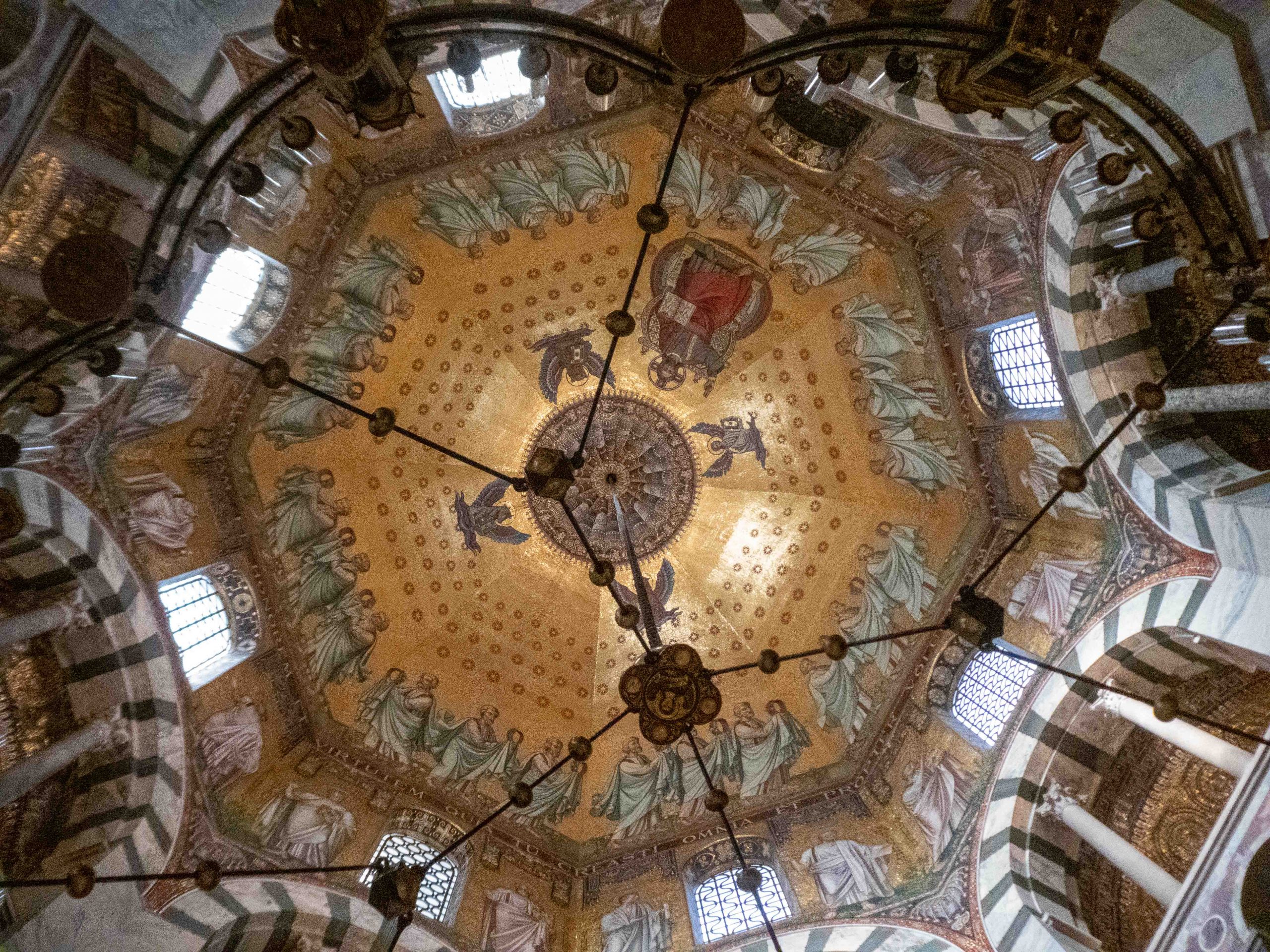


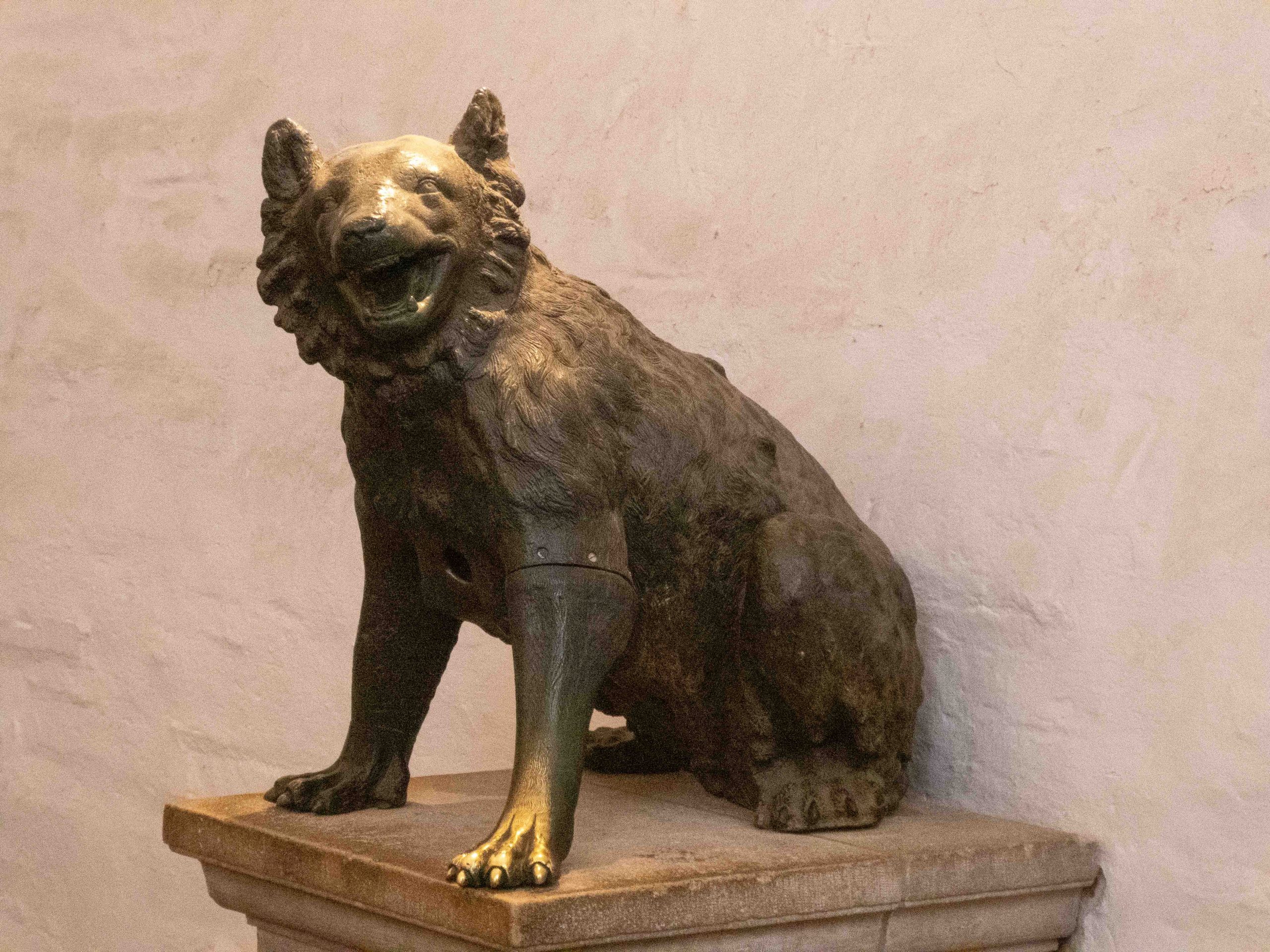

After the Dom, I visit the Charlemagne Museum (which also has an App) but do not learn as much as I am expecting in its rather confusing interior. Then I chance across the Dom Church Treasury, and am glad to be drawn in by curiosity, mostly for the near life size objects below, and to be reminded how good gold can look under the right light. The bust is of Charlemagne, and is a reliquary suposedly containing a section of his skull.


By now in need of a bun, I chance across a shop in Ponttor Street whose window dispay reminds me of Fitzbillies in Cambridge famous for its Chelsea buns. In I go. These are Cinnamon buns. I have one and it is good. I also have a creme brulee cappucino made with a blow torch which is more of an amusing idea.


My day in Aachen has been good and I could go home tomorrow.
Friday 10th February: Aachen (with a quick trip to Brussels)
I can’t face going home today. My head’s in a bit of turmoil. This has been such a good trip. What awaits? And on a practical note, I could get to Brussels and find there are no Interrail spaces left on Eurostar. I’d like my last day to be chilled. So I book in for another day.
I have a good chat with the hotel staff about breakfasts and what happens to the remains of the seemingly obligatory wide buffet spread of fruits, meats, meusli’s, cheeses, breads, etc found in hotels that offer breakfast. Then I use one of my remaining train days to pop to Brussels, one hour away, for a Eurostar reservation. I’m told in summer you have to do this months in advance, but it is not summer and it is no problem.
Back in Aachen, I walk around the old town streets for a final time. I walk to the Lindt & Sprungli factory shop out past Ponttor interested to see how cheaply they sell their chocolate – the answer is two-fold, not very and seen en masse their products seem anyway far less desirable – and come away with one small bag of their new vegan praline eggs to try (they are nice). On the way back, I find an alternativey cafe that does excellent thick lentil soup, which is exactly what I need after too much sweet stuff these last days.
Saturday 11th February: Aachen to Sidmouth: the End
Today I go home. I catch the 12.21 from Aachen to Brussels, the Eurostar at 14.52, gain an hour and catch the 17.04 from Paddington arriving into Exeter at 19.10. Everything goes smoothly. I meet Sally for a light supper and catch-up, then get the 22.05 bus to Sidmouth, discovering as I do so that the Exeter-Sidmouth buses now run every 90 minutes instead of hourly. Then I am home and my trip is over!
As an afterword, I am aware that Michael, the lonesome skier from Finse last seen setting off into a snowstorm, should have crossed the high snowy plateau by now. I have worried about him, so I send him a message via Instagram, and as I write this last entry, he messages me to say he is safely back home in France.
The End